A Complete Guide to Custom Jacket Manufacturing for Emerging Fashion Brands
- Share
- publisher
- Chanjoye
- Issue Time
- Jul 24,2026
Summary
Comprehensive guide to custom jacket manufacturing. Cover jacket types, fabric selection, construction techniques, MOQ considerations, and how emerging brands can source quality outerwear.
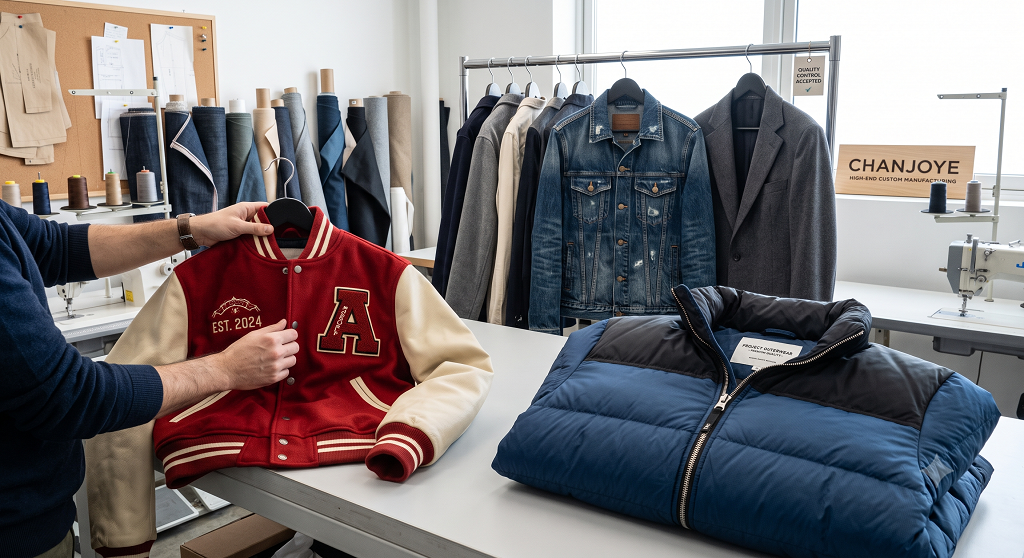
Launching a fashion brand is exhilarating. You have the vision, the designs, and the audience in mind. But when it comes to outerwear—jackets, coats, and structured pieces that define seasons—many emerging brands hit a wall. Jacket manufacturing is fundamentally different from producing t-shirts or hoodies. It involves complex pattern-making, multi-layer construction, specialized machinery, and a supply chain that can make or break your debut collection. Get it wrong, and you're looking at costly samples, delayed launches, and inventory that doesn't meet your quality standards. This guide is your complete reference to custom jacket manufacturing—distilled from over two decades of working with fashion brands that have successfully scaled from concept to retail. Whether you're designing your first varsity jacket, a techwear parka, or a refined wool topcoat, understanding the manufacturing landscape is your competitive advantage. The global outerwear market continues its steady expansion, driven by the convergence of fashion and function. A growing number of emerging streetwear and contemporary fashion brands are entering the segment, recognizing that jackets command higher price points, stronger brand perception, and deeper customer loyalty than basic apparel categories. A well-made jacket becomes a statement piece—one that customers associate directly with your brand identity. Custom jacket manufacturing differs from mass-production OEM in several critical ways. When you choose custom manufacturing, you control the fabric, fit, hardware, labeling, and every finish detail. This level of control is what separates a premium streetwear label from a generic clothing line. The right manufacturing partner, like Chanjoye, a leading high-end custom streetwear manufacturer with over 20 years of experience serving premium and luxury streetwear brands worldwide, provides not just production capacity but design consultation, fabric sourcing, and QC rigor that emerging brands desperately need. Before you discuss fabrics and MOQ, you need clarity on what type of jacket you're producing. Each category demands different machinery, skill sets, and production timelines from your manufacturing partner. Varsity & Letterman Jackets: The resurgence of varsity style in streetwear has made this category one of the fastest-growing in custom manufacturing. These jackets typically combine wool-blend bodies with genuine or synthetic leather sleeves, requiring press machines for chenille patches, chain-stitch embroidery equipment, and specialized snap-button hardware stations. The melton wool and leather pairing demands skilled cutters who understand grain direction for both materials. Puffer & Down Jackets: This technical category requires expertise in fill-power management, baffle construction, and down-proof fabric handling. Manufacturers need dedicated down-filling rooms with controlled environments to manage fill distribution. The quilting patterns—whether horizontal, diamond, or chevron—must be precision-stitched to prevent down migration. Fill power ratings (550FP to 900FP) directly impact warmth-to-weight ratios and your production cost. Denim & Trucker Jackets: Denim jacket manufacturing relies on heavyweight sewing machines, bartack reinforcement, and specialized wash facilities for enzyme washes, stone washes, and distressed finishes. The post-production wash process can add 5-10 days to your timeline and significantly affects the final hand feel and color consistency. Bomber & Flight Jackets: Bomber jackets demand precise rib-knit trim attachment at cuffs, collar, and hem—a deceptively technical operation that separates experienced manufacturers from novices. The body fabrics range from nylon and polyester to premium satin and leather, each requiring different needle types and thread tensions. Technical & Performance Jackets: For brands entering the athleisure or outdoor crossover space, technical jackets involve seam-sealing, waterproof zippers, taped seams, and breathable membrane lamination. These require specialized heat-sealing equipment and waterproof testing rigs that not all factories possess. When you work with an experienced partner like Chanjoye, you gain access to multiple production lines specializing in different jacket types, allowing you to maintain quality consistency as your product range expands. Visit our products page to explore the full range of capabilities available. Fabric is where your brand story begins—and where many emerging brands make costly mistakes. The tactile quality of your jacket is the first thing customers notice, and it shapes every subsequent perception of your brand's value. Key Fabric Categories for Jacket Manufacturing: Nylon and polyester shells dominate the technical and casual jacket space. Nylon offers superior abrasion resistance and a subtle sheen that photographs beautifully. Polyester provides excellent color retention and wrinkle resistance. For premium positioning, consider nylon 6.6 with a matte finish, which delivers a refined hand feel that distinguishes high-end streetwear from mass-market alternatives. Wool blends—particularly melton wool for varsity jackets and boiled wool for tailored coats—provide natural temperature regulation and a luxurious weight that synthetic alternatives cannot replicate. The GSM (grams per square meter) range for quality jacket wool typically falls between 400-600 GSM, balancing warmth with structured drape. Cotton canvas and twill remain staples for workwear-inspired jackets. Waxed cotton, in particular, has seen a renaissance in premium menswear and streetwear circles. The waxing process adds water resistance and develops a unique patina over time, giving each jacket a one-of-a-kind character. When sourcing fabrics, always request lab dips and hand-feel swatches before committing to bulk production. A fabric that looks right on screen may feel completely different in hand, and haptic quality is non-negotiable for outerwear. Reach out to discuss fabric options tailored to your specific jacket design. The difference between a jacket that lasts two seasons and one that lasts a decade lies in construction. Understanding these techniques empowers you to specify quality with confidence when communicating with your manufacturer. Seam Construction: Flat-felled seams are the gold standard for durability, encasing raw edges on both sides of the seam. For lightweight shells, French seams offer a clean interior finish. Topstitching with double-needle machines adds both structural reinforcement and visual detail that elevates perceived quality. Edge-stitching at 2-4mm from seam lines demonstrates precision manufacturing. Interfacing and Lining: Quality jackets use fusible or sew-in interfacing at collars, cuffs, plackets, and pocket openings to maintain shape through repeated wear. The lining fabric—whether viscose, cupro, polyester, or quilted nylon—should be selected for breathability, static resistance, and ease of donning. Premium manufacturers pattern-match linings to body panels rather than using generic bagged lining constructions. Hardware Selection: Zippers, snaps, buttons, and drawcords are the functional touchpoints customers interact with daily. YKK zippers remain the industry benchmark across all price tiers. For premium positioning, consider custom-engraved pullers, electroplated finishes on snaps, and reinforced bartack stitching at all hardware attachment points. The satisfying click of a quality snap closure communicates craftsmanship instantly. At Chanjoye, every jacket undergoes multi-point construction review—from initial cutting to final pressing—ensuring that seams lay flat, hardware functions smoothly, and the garment maintains its intended silhouette through the production process. Minimum Order Quantity (MOQ) is the single most anxiety-inducing term for emerging fashion entrepreneurs. Jacket MOQs typically start higher than basic apparel categories because of the material minimums from fabric mills and the setup complexity of production lines. However, strategic manufacturing partnerships can significantly lower barriers to entry. For custom jacket manufacturing, typical industry MOQs range from 100-500 pieces per style per color. However, the right manufacturing partner—one that understands the emerging brand journey—can work with significantly smaller initial runs. We offer flexible MOQ starting at 50-100 pieces so premium brands can test quality before scaling their production volume. Locking fabric is a critical consideration: mills require minimum yardage that may exceed your first-run needs. Strategic solutions include selecting from in-stock fabric inventories, pooling minimums across colorways within the same fabric, or negotiating greige (undyed) fabric reservations that can be piece-dyed for different colorways. For custom fabric development, expect to commit to 500-1000 meters minimum per color. Pro tip: Start with 2-3 core colorways using the same fabric base, rather than spreading your MOQ across 5+ colors. This gives you sufficient depth in each SKU while meeting mill minimums. As your brand gains traction, expand colorways incrementally based on sell-through data rather than pre-launch assumptions. Understanding the jacket development timeline is essential for planning your collection launch. A realistic development-to-delivery cycle spans 8-16 weeks depending on complexity. Phase 1 — Tech Pack & Pattern Development (2-3 weeks): Your tech pack must include detailed flat sketches with callouts for every seam, pocket, and hardware placement. Include measurement specifications for each size in your grade rule. The pattern maker creates the base size pattern, which then undergoes grading to your full size range. Digital pattern-making via CAD reduces iteration time and improves grading accuracy. Phase 2 — Sampling & Fit Refinement (3-5 weeks): The first sample reveals how your 2D design translates to a 3D garment. Expect at least two rounds of sampling: the first for silhouette and construction review, the second for fit refinements and fabric/hardware confirmation. Rush sampling sacrifices detail; plan adequate calendar time. Phase 3 — Pre-Production & QC Setup (2-3 weeks): Create a sealed reference sample (the "golden sample") that defines the exact quality standard for bulk production. Establish your QC checkpoints: inline inspection during production, final random inspection (AQL 2.5 is standard for apparel), and pre-shipment inspection before goods leave the factory. Phase 4 — Bulk Production & Delivery (3-5 weeks): Production runs once all materials are in-house and the production line is set up. Shipping method (air freight vs. sea freight) adds 3-30 days to your timeline. Factor in customs clearance, especially if you're importing into the US or EU markets. Throughout this process, Chanjoye provides milestone updates and transparent communication, ensuring that your brand's vision is faithfully executed at every stage. Learn more about our development approach on our blog. Selecting a jacket manufacturer is not a transactional decision—it is a strategic partnership that directly impacts your brand's reputation, margins, and growth trajectory. Here are the key evaluation criteria: Specialization & Capability Match: A factory that excels at t-shirts may struggle with structured jackets. Verify that your partner has dedicated outerwear production lines. Ask about their specific equipment: do they have the press machines for patches, the specialized sewing machines for heavy fabrics, the down-filling stations for puffers? Communication Infrastructure: Language barriers, time zone gaps, and unclear point-of-contact structures are the leading causes of production errors. A partner with English-proficient account managers, WeChat/WhatsApp accessibility, and regular production updates significantly reduces your risk. Quality Certifications: Look for recognized certifications that validate manufacturing standards. OEKO-TEX Standard 100 certification ensures that every component—from fabric to thread to buttons—has been tested for harmful substances. GOTS (Global Organic Textile Standard) certification applies if you're using organic materials. ISO 9001 indicates systematic quality management processes. Transparency & References: A quality manufacturer will provide client references, factory tour options (virtual or in-person), and transparent pricing breakdowns. Be wary of partners who refuse to share their production facility details or cannot articulate their QC process clearly. Industry resources like OEKO-TEX and GOTS provide databases of certified facilities. Professional associations such as the American Association of Textile Chemists and Colorists (AATCC) offer testing standards that help you set clear quality expectations with your manufacturer. If you're ready to explore a manufacturing partnership, contact us today to discuss your jacket collection vision. Quality control in jacket manufacturing is multi-dimensional—it covers materials, construction, fit, and finish. A systematic QC framework prevents the disappointment of receiving bulk production that doesn't match your approved sample. Material Inspection: Before cutting begins, all fabric rolls should undergo 4-point inspection to identify defects. Check shade continuity across rolls using a lightbox under D65 lighting conditions. Hardware components should be tested for finish durability via salt-spray testing for metal parts and pull-force testing for zippers. In-Line Production QC: Inspectors should check garments at 20-30% completion (after main body assembly) and at 80% completion (before final pressing). This catches construction issues early, preventing entire batches from being produced with the same defect. Final Random Inspection: Using AQL 2.5 (Major defects) and AQL 4.0 (Minor defects), randomly sample finished jackets from the production lot. Check measurements against your spec sheet, verify seam strength with a seam-slippage test, and inspect all hardware functionality across the sample. Fit Consistency: Jacket fit is particularly sensitive to production variance because of the multi-layer construction. Measure key points (chest, shoulder, sleeve length, body length) on every garment in your inspection sample. A tolerance of ±0.5 inches for critical measurements is standard for premium outerwear. Chanjoye integrates these QC protocols into every production run, with dedicated QC teams that are independent from the production line—ensuring objective quality assessment at every stage. Transparent cost understanding empowers you to price your jackets correctly and maintain healthy margins. Here is how a typical custom jacket production cost breaks down: Fabric typically accounts for 35-50% of the total production cost, with premium fabrics like Italian wool, Japanese selvedge denim, or technical membranes at the higher end. Labor costs (cutting, sewing, finishing) represent 25-35%, varying by construction complexity. A fully-lined jacket with multiple pockets, reinforced seams, and detailed topstitching requires 2-3 times the labor hours of a simple unlined shell. Hardware costs (5-10%) include zippers, snaps, buttons, drawcords, and labels. Packaging, quality control, and logistics complete the remaining 10-15%. For emerging brands, Chanjoye provides value-driven premium manufacturing—superior craftsmanship at fair market rates that reflect the meticulous attention to detail your outerwear deserves, not just the lowest possible price point. What is the minimum MOQ for custom jackets? While industry standard MOQ starts at 200-500 pieces, flexible manufacturing partners can accommodate 50-100 pieces for emerging brands testing their first collection. Expect slightly higher per-unit costs at lower quantities due to material minimums and production setup overhead. How long does custom jacket manufacturing take? A complete cycle from tech pack approval to delivery typically spans 8-16 weeks: 2-3 weeks for pattern-making, 3-5 weeks for sampling and fit refinement, 2-3 weeks for pre-production setup, and 3-5 weeks for bulk production. Rush timelines are possible but increase the risk of quality issues. Can I mix different jacket styles in one production order? Yes, but each distinct style requires separate pattern-making, sampling, and production line setup. Grouping styles that share the same base fabric can reduce material minimums. Discuss your collection architecture with your manufacturer during the planning phase. What fabric certifications should I look for? OEKO-TEX Standard 100 certification ensures all components are tested for harmful substances—this is the baseline expectation for responsible manufacturing. For organic materials, GOTS certification covers both environmental and social criteria throughout the supply chain. How do I ensure consistent sizing across my jacket collection? Start with a well-documented graded spec sheet with measurement tolerances defined for each size. Use the same fit model for all samples in your collection. Maintain a sealed reference sample for each style that the factory must match during bulk production. Custom jacket manufacturing is a journey that rewards preparation, partnership, and patience. The emerging brands that succeed are not necessarily those with the largest budgets, but those who invest time in understanding the manufacturing process, select partners aligned with their quality standards, and prioritize craftsmanship over shortcuts. Whether you're designing your debut varsity jacket, a technical parka for the urban explorer, or a minimalist wool coat that anchors a capsule collection, the principles in this guide provide your foundation. The next step is finding a manufacturing partner who shares your commitment to excellence—one who brings two decades of outerwear expertise, premium material relationships, and the quality infrastructure to bring your vision to life. Ready to start your jacket collection? Send us your design brief and let's discuss how Chanjoye can turn your outerwear concepts into market-ready products.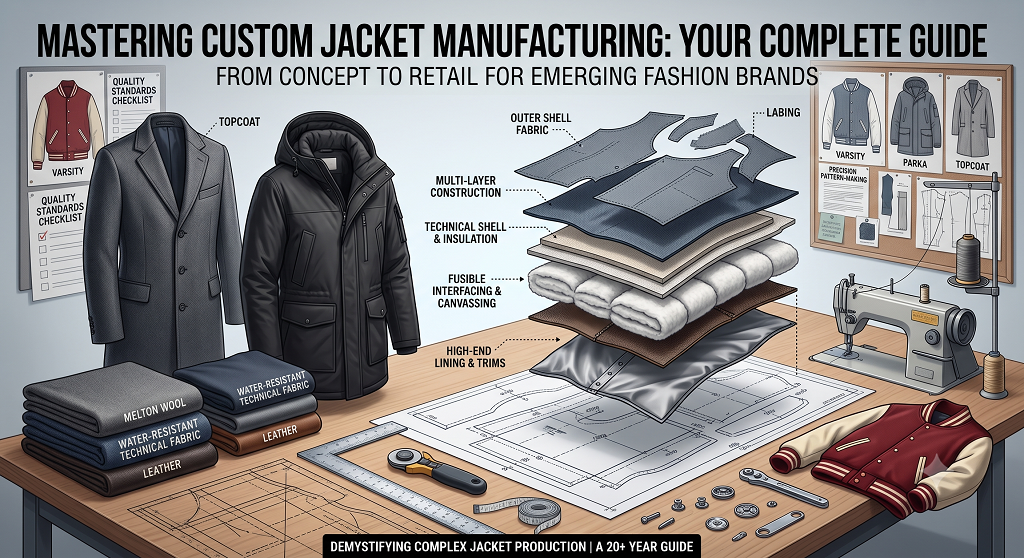
Understanding the Custom Jacket Manufacturing Landscape
Types of Jackets: Choosing the Right Silhouette for Your Brand
Fabric Selection: The Foundation of Quality Outerwear
Construction Techniques That Define Premium Jackets
Navigating MOQ: Strategic Production for Emerging Brands
The Custom Jacket Development Process: From Concept to Production
Sourcing the Right Manufacturing Partner
Quality Control: Ensuring Consistency in Every Piece
Cost Breakdown: Understanding Your Investment
Frequently Asked Questions
Taking the Next Step