Custom Jeans Manufacturing: How Denim Customization Is Reshaping Street Fashion
- Share
- publisher
- Chanjoye
- Issue Time
- Aug 13,2026
Summary
Explore how custom jeans manufacturing is transforming street fashion. Covers denim weights, wash techniques, distressing methods, and how brands can leverage custom denim.
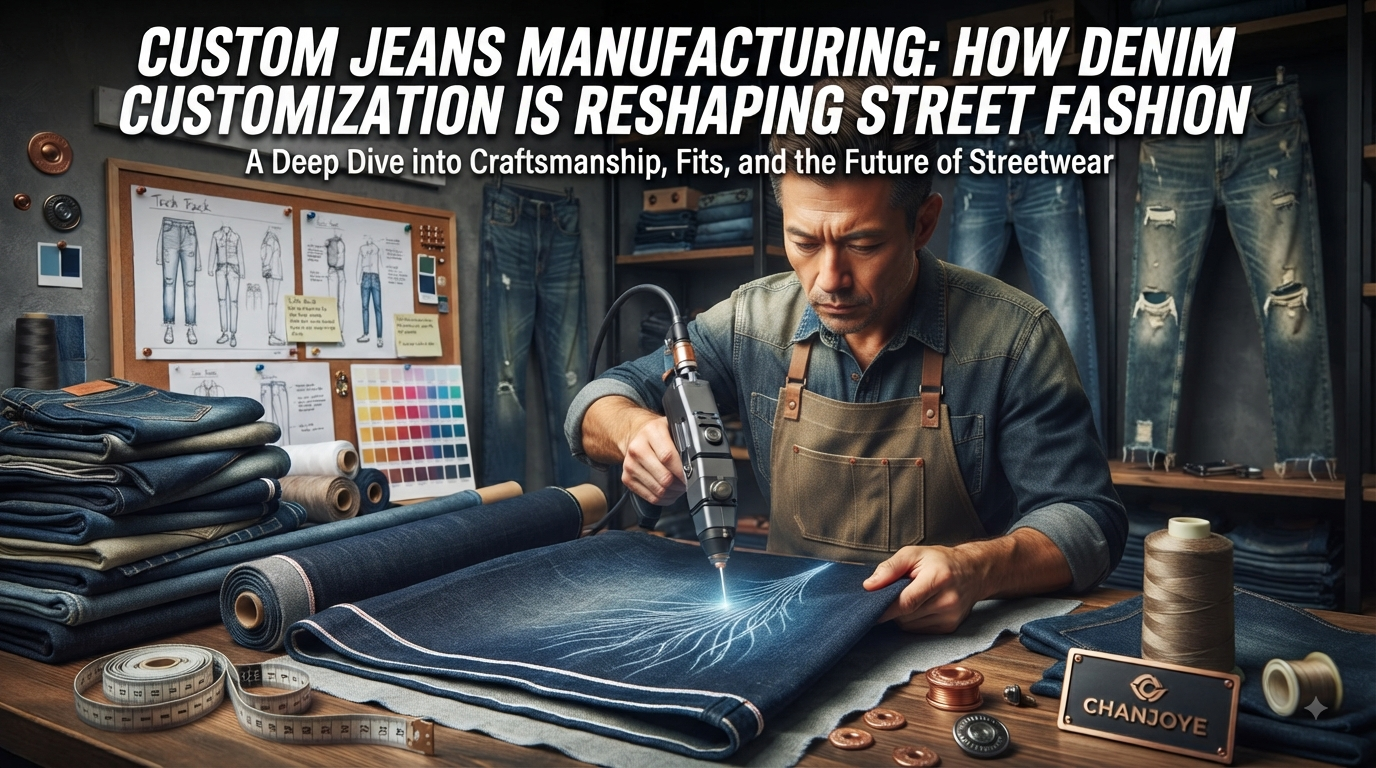
Denim has never been a passive category. For more than a century it has carried working-class grit, counterculture rebellion, and high-fashion prestige in equal measure. Today, the most interesting denim is no longer coming from the giants that defined the 1990s and 2000s — it is coming from independent streetwear labels, direct-to-consumer startups, and boutique designers who treat every pair of jeans as a statement piece rather than a stock unit. The global denim market remains one of the largest segments in apparel, measured in the tens of billions of dollars annually, and a growing share of that value is flowing to brands that commission their own fits, fabrics, washes, and detailing instead of ordering blanks. Yet most emerging labels are still buying generic denim and hoping their logo will be enough. The result is predictable: a collection that looks identical to dozens of others, sizing that fits inconsistently across production runs, and no real story to tell a customer who is increasingly educated about fabric weight, wash character, and construction quality. This is the gap that custom jeans manufacturing exists to close. In this guide, we break down how denim customization is reshaping street fashion — from fabric weights and wash techniques to distressing methods, production steps, certifications, and the practical question of choosing a manufacturing partner. Whether you are planning your first denim drop or scaling an established line, this is the roadmap. Mass-market denim is engineered for the lowest common denominator. A factory running hundreds of thousands of units per style has to standardize every variable — fabric, fit, wash, and hardware — to keep the line moving. That standardization is exactly what a streetwear or premium brand cannot afford. When every label sources from the same handful of open-stock programs, the market fills with interchangeable product, and price becomes the only remaining point of difference. The problems compound quickly. Generic fits rarely map to the modern silhouettes streetwear customers actually want, whether that is a roomy straight leg, a sharp taper, or an exaggerated wide cut. Wash treatments are limited to a handful of pre-defined recipes, so your "vintage fade" looks identical to the brand next door. Sizing drifts from batch to batch, driving returns and eroding trust. And because the product carries no proprietary construction, a competitor can source the same silhouette within weeks. For a brand built on identity, this is a quiet crisis. The product itself — the thing customers hold, wear, and photograph — stops communicating anything unique. Customization is not a luxury add-on; it is the mechanism by which a label reclaims control of its own aesthetic. The appeal of open-stock denim is obvious: low upfront commitment and fast availability. But the real cost shows up later, in places that rarely appear on a purchase order. Consider inventory risk. When you buy generic jeans, you are committing to a fit and wash that has no built-in demand — if it does not sell, you eat the markdown, and denim is heavy and expensive to store. Then there is the return problem. Ill-fitting or inconsistent denim produces a disproportionate share of size and fit returns, and every return is a double cost: the logistics of the return itself plus a lost customer relationship. There is also the opportunity cost of blending in. When your jeans look like everyone else's, you compete on discounting, which steadily compresses margin and positions your brand at the bottom of the market — the opposite of where a quality-led label wants to be. Finally, generic production makes iteration painfully slow. If you want to tweak a rise, deepen a wash, or swap a fabric weight, you are back to square one with a new supplier search. Custom manufacturing, by contrast, treats the garment as a living specification that you refine across drops. Custom jeans manufacturing turns denim from a commodity into a proprietary asset. Instead of choosing from a supplier's existing line, you specify the fabric weight, weave, fit block, wash recipe, hardware, and detailing — then produce it in volumes that make sense for your stage of growth. This is where a partner like Chanjoye comes in. Chanjoye, a leading high-end custom streetwear manufacturer with over 20 years of experience serving premium and luxury streetwear brands worldwide, helps labels build signature denim programs rather than off-the-shelf silhouettes. The practical advantages are immediate. You gain exclusivity: your wash, your fit, your selvedge detail, your hardware. You gain consistency: a documented tech pack and a dedicated factory line mean the pair your customer receives matches the sample you approved. And you gain narrative: "custom-milled 14-ounce denim with a proprietary enzyme wash" is a story that justifies premium positioning and converts a $60 commodity jean into a $160 statement piece. Importantly, custom does not have to mean massive volume. Quality-focused manufacturers now offer flexible minimum order quantities — often starting around 50 to 100 pieces per style — so emerging brands can validate a design and test market response before committing to scale. This is a service for precision, not a race to the bottom on price. Denim weight is the single most important variable in how a pair of jeans looks, drapes, and lasts. It is traditionally expressed in ounces per square yard (oz), though many mills also quote grams per square meter (GSM). The two are convertible — roughly one ounce per square yard equals about 34 grams per square meter — and understanding both helps you speak the language of mills and factories precisely. For streetwear, heavyweight denim in the 13 to 16-ounce range is the sweet spot. It holds crisp creases, resists bagging at the knees, and photographs with the rigid, structured silhouette that premium streetwear buyers expect. Lighter weights are better for relaxed summer drops or wide-leg styles that need soft movement. Your choice should always trace back to the fit story you are telling. The wash is where denim develops its personality. Two pairs cut from the same fabric can look entirely different depending on how they are finished, which is why wash capability should be a core criterion when you evaluate any denim partner. Each of these can be layered and customized — a stone wash followed by a light enzyme finish, for instance — to produce a signature look no competitor can easily copy. This is where a capable factory turns a specification into a brand asset. Distressing is the art of making new denim look lived-in, and it is one of the clearest signals of a premium product when done well — and of a cheap one when done badly. The techniques have evolved significantly as the industry has moved toward safer, more precise methods. Whiskering creates the crease fades that radiate from the crotch and hip, typically applied with hand sanding or templates. Hand sanding and grinding produce localized abrasion at the knees, thighs, and hems for a natural worn pattern. Rips, frays, and patched repairs add the deconstructed character that defines much of contemporary streetwear. Laser distressing, the newest major tool, etches whiskers and fades with pixel-level precision and no water or manual abrasion — a faster, more consistent, and more sustainable alternative. One technique worth avoiding entirely is sandblasting, which was widely banned after it was linked to silicosis among workers. Reputable manufacturers have moved to laser, hand sanding, and mechanical abrasion instead. When you evaluate a factory, its distressing methods are a good proxy for its overall standards. Understanding how a custom denim order flows from idea to finished product will make you a sharper buyer and a better partner. The sequence is consistent across reputable manufacturers, including Chanjoye's production workflow. At each stage, clear communication and an approved reference sample prevent the drift that plagues generic production. The best partners treat the sample as a contract, not a suggestion. Premium denim is built differently, and educated customers can feel the difference before they can name it. The markers are specific and worth insisting on. Selvedge denim, woven on narrow shuttle looms with a self-finished edge, is a hallmark of heritage quality and is often rolled at the cuff to show it off. Chain-stitched hems create a subtle roping effect as they fade — a detail denim enthusiasts look for. Reinforced construction matters too: bar-tacked stress points, riveted pocket corners, and flat-felled seams all signal a garment engineered to last rather than one built to a price point. Fit is where customization pays for itself. The rise, thigh, knee, and leg opening can all be tuned to a single coherent silhouette — a true tapered cut, a relaxed straight leg, or a stacked wide fit — instead of whatever the open-stock market happens to offer this season. This is the difference between a jean that fits and a jean that flatters. Denim has a reputation as a water- and chemical-intensive category, and modern buyers increasingly want to know how their jeans are made. Certifications have become the shorthand for trust, and they carry real weight in a premium brand's story. The OEKO-TEX STANDARD 100 label verifies that every component of a garment — thread, buttons, rivets, fabric — has been tested against a list of more than 1,000 harmful substances and is safe for human health. The Global Organic Textile Standard (GOTS) is the leading benchmark for organic fibers, covering both environmental criteria and social and human-rights requirements across the supply chain. Organizations such as Textile Exchange track the industry's broader shift toward preferred and recycled materials. For a brand, these certifications are not just compliance boxes — they are marketing assets. A pair of custom jeans made from certified fabric and finished with a responsible enzyme wash gives you a defensible, differentiating story for a customer base that increasingly votes with its values. Not every factory that claims to make denim can actually deliver premium custom work. Here is what to look for when you evaluate a partner. Chanjoye's two decades in premium streetwear manufacturing have been built on exactly these capabilities — fabric expertise, in-house finishing control, flexible MOQs, and rigorous QC — which is why quality-led labels trust the team with their denim programs. When you are ready to move beyond generic denim, a conversation with a specialist is the fastest way to understand what is possible for your line. Browse the product catalog to see the range of custom garments available, and reach out through the contact page or send an inquiry to discuss your denim project. Minimum order quantities vary by manufacturer, but quality-focused partners often offer flexible MOQs starting around 50 to 100 pieces per style, letting emerging brands validate a design before scaling. Depending on complexity, sampling and bulk production for custom denim typically run from a few weeks for sampling to several weeks for bulk, with wash-heavy or heavily distressed designs taking the longest. Heavyweight denim in the 13 to 16-ounce range is the most common choice for structured streetwear silhouettes, while lighter 10 to 12-ounce fabrics suit relaxed summer cuts and wider fits. Yes. Reputable manufacturers can source fabrics certified to standards such as OEKO-TEX STANDARD 100 and GOTS, and can pair them with lower-impact finishing methods like enzyme and laser treatment. Custom jeans manufacturing is more than a production method; it is a strategic decision about what kind of brand you are building. For labels that want durable, distinctive denim with a story behind every pair, the path runs through specialized manufacturing rather than open-stock sourcing.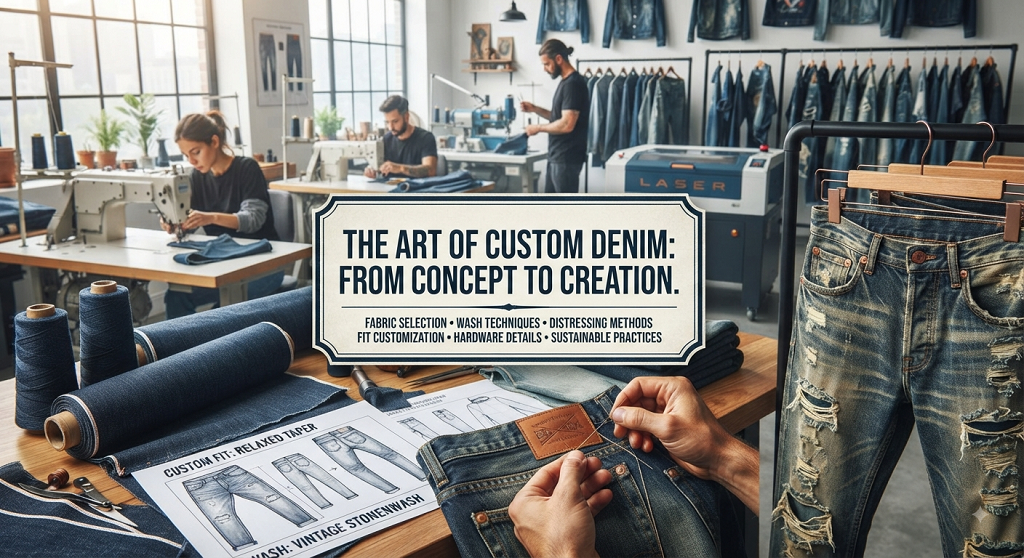
Why Off-the-Shelf Denim Is Failing Modern Brands
The Hidden Costs of Generic Denim Production
Custom Jeans Manufacturing: The Denim Solution That Scales With You
Understanding Denim Weights: Oz vs. GSM and What They Mean
Weight Class Oz / Sq Yd Approx. GSM Best For Lightweight 5–9 oz 170–305 GSM Summer jeans, drapey relaxed fits, soft hand Midweight 10–12 oz 340–407 GSM Everyday denim, versatile year-round wear Heavyweight 13–16 oz 440–542 GSM Structured streetwear, durable workwear-style cuts Ultra-heavy 16+ oz 542+ GSM Raw selvedge, heritage and premium denim heads Wash Techniques That Define Your Denim's Character
Distressing and Finishing: From Whiskering to Laser Detailing
The Custom Jeans Production Process, Step by Step
Fit and Construction: What Separates Premium Denim from Mass-Market
Sustainability and Certifications in Modern Denim
How to Choose the Right Custom Jeans Manufacturer
Frequently Asked Questions About Custom Denim
What is a typical MOQ for custom jeans?
How long does custom denim production take?
What denim weight should I choose for streetwear?
Can I use sustainable or certified fabrics?
Key Takeaways: Making Custom Denim Work for Your Brand