From Tech Pack to Bulk Production: The Step-by-Step Apparel Manufacturing Process
- Share
- publisher
- 11
- Issue Time
- Jun 23,2026
Summary
Transforming a streetwear design from a creative sketch into bulk retail products is a complex and technical supply chain journey. As a leading professional streetwear clothing manufacturer, Vainnx (https://www.vainnx.com/) understands the key pain points fashion brands face when transitioning from a tech pack to high-volume manufacturing.
Introduction:
In the hyper-competitive global streetwear market, the success of a fashion brand relies not only on unique visual creativity but also on the precision and execution of its underlying supply chain. Many emerging streetwear brand owners and independent fashion designers possess stunning graphic concepts, yet they frequently encounter severe roadblocks when launching products due to a lack of understanding of the actual custom apparel manufacturing process.
As a professional streetwear clothing manufacturer serving over 200 trendy labels and designer brands globally, Vainnx (https://www.vainnx.com/) understands what it takes to bring high-end streetwear to life. Streetwear inherently differs from standard apparel; it demands rigorous specifications regarding fabric weight (such as 400g-600g heavy cotton), specialized washing techniques (like acid wash or sun-fade effects), premium graphics (such as 3D puff printing or silicone embossing), and precise silhouettes (like iconic oversized fits).
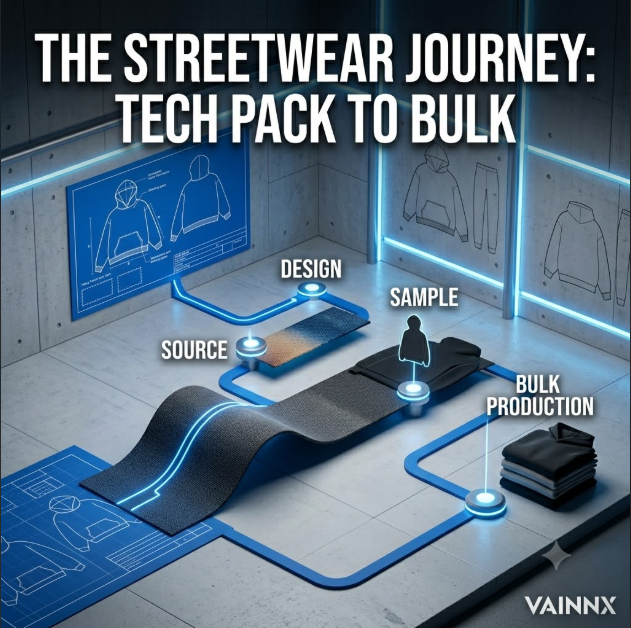
To keep your brand agile and premium in a shifting market, this article explores the six standard industrial stages of the production pipeline from a factory's perspective—guiding you smoothly from a tech pack to bulk apparel production steps—while revealing how an elite manufacturer executes strict quality control throughout.
Phase 1: The Tech Pack — The Industrial Blueprint of Apparel Production
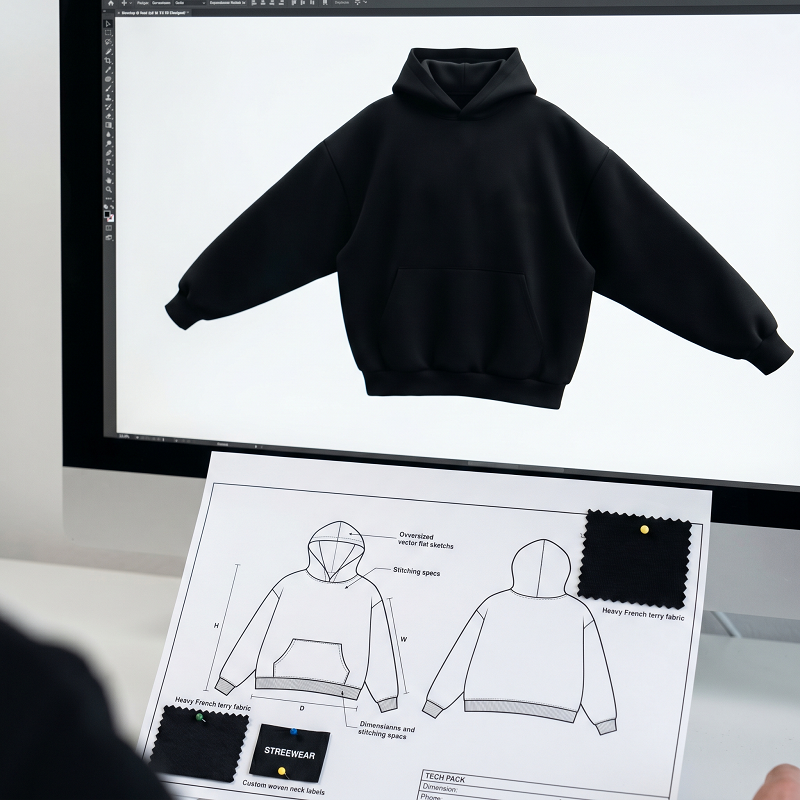
In the garment industry, there is a golden rule: "Without a perfect tech pack, there can be no qualified bulk production." A tech pack for clothing production is the primary universal language spoken between fashion designers and garment factories. It is far more than a simple concept sketch; it is a highly detailed industrial manual containing every single manufacturing parameter.
1. What Are the Core Elements of an Industrial Tech Pack?
A comprehensive tech pack must consist of the following essential modules. Any omission here will directly result in failed samples or costly bulk reworks:
Technical Flats / CAD Sketches: Clear black-and-white vector line drawings illustrating the front, back, and side profiles. It must accurately highlight stitching details (e.g., double-needle topstitching, flatlock seams), pocket structures, zipper configurations, and critical construction methods.
Bill of Materials (BOM): This serves as the absolute "bible" for the clothing factory's purchasing department. It explicitly itemizes primary shell fabrics (e.g., 100% heavyweight cotton French terry), contrast fabrics, trims (e.g., custom YKK zippers, high-elasticity polyester ribbing), sewing thread specifications, woven neck labels, satin care labels, and hangtags—specifying exact materials, quantities, and Pantone color codes.
Size Specification & Grading Table: Detailed spreadsheets specifying the absolute measurements for every size (S, M, L, XL, XXL) across all key construction points of the garment (chest width, body length, shoulder slope, sleeve length, cuff opening, and collar circumference). For streetwear where an oversized fit is paramount, the drop-shoulder slope and armhole depth grading ratios must be mathematically accurate.
Artwork & Embellishment Specs: If the garment features advanced graphics, the tech pack must define the absolute geometric placement (e.g., "centered X cm below the front collar seam"), exact physical dimensions of the artwork, and precise execution parameters (e.g., the physical height of a 3D puff print or ink transparency).
2. Pro Tips from Vainnx Engineering Experts
As an experienced clothing manufacturer, Vainnx frequently observes startup brands submitting raw hand-drawn sketches or 3D software mockups lacking actual dimensions. This invariably lengthens the sampling iteration cycle. Vainnx utilizes a dedicated 10-person in-house design and development team to help brands systematically convert basic conceptual ideas into industry-standard tech packs, laying a flawless foundation for agile manufacturing.
Phase 2: Sourcing & Fabric/Trim Development
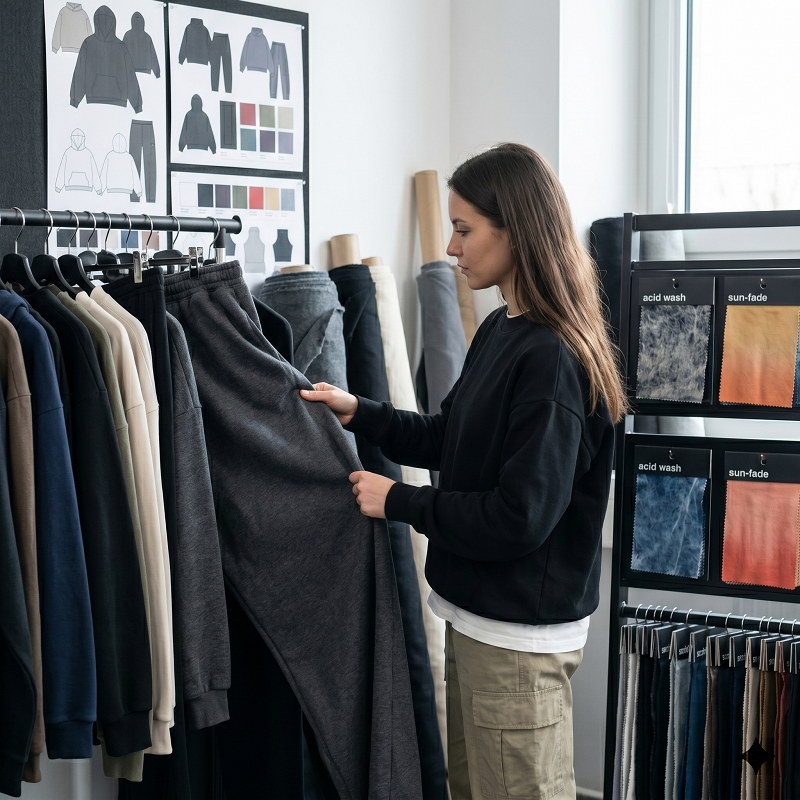
The soul of streetwear lies within its tactile hand-feel and weight distribution (drape). An elite apparel manufacturer does not merely execute sewing operations; they proactively engineer premium textiles and pioneering fabric treatments.
1. Standard Fabric Options for Premium Streetwear
Within the extensive Vainnx fabric archives, we consistently source and offer the following premium fabrics tailored specifically for high-end streetwear drops:
Heavyweight Cotton: Ranging from 300gsm, 400gsm, up to ultra-heavy 600gsm knits. These fabrics offer a dense, structured texture capable of holding the boxy or oversized architectural shapes demanded by modern street culture.
Premium French Terry & Brushed Fleece: Extensively utilized for high-tier hoodies and sweatshirts. The internal loops are tightly woven for a smooth skin-feel, delivering optimal warmth retention without sacrificing breathability.
Sustainable & Certified Textiles: Including OEKO-TEX® certified organic cotton and recycled polyester, satisfying the modern consumer's demand for eco-conscious and sustainable fashion initiatives.
2. Advanced Garment Washing Implementations
Top-tier streetwear garments often undergo intensive wet processing post-knitting or post-assembly. Operating as a full-service OEM ODM streetwear supplier, Vainnx incorporates advanced laundry capabilities into the early sourcing phase:
Acid Wash & Stone Wash: Infuses the textile with an authentic, distressed vintage patina, producing beautifully high-contrast faded seams.
Sun-Fade Effects: Replicates natural localized solar fading along the shoulders, hood edges, and hems, providing a highly sought-after artisanal aesthetic.
3. Bespoke Trims & Hardware Customization
Neck labels, care instructions, and metallic hardware (like heavy-duty branded buttons or zipper pullers) represent critical touchpoints determining a brand's luxury positioning. Vainnx offers complete customization for these components, ensuring custom woven tags and satin care labels are sampled simultaneously with the fabric.
Phase 3: Precision Sampling & Pattern Perfecting
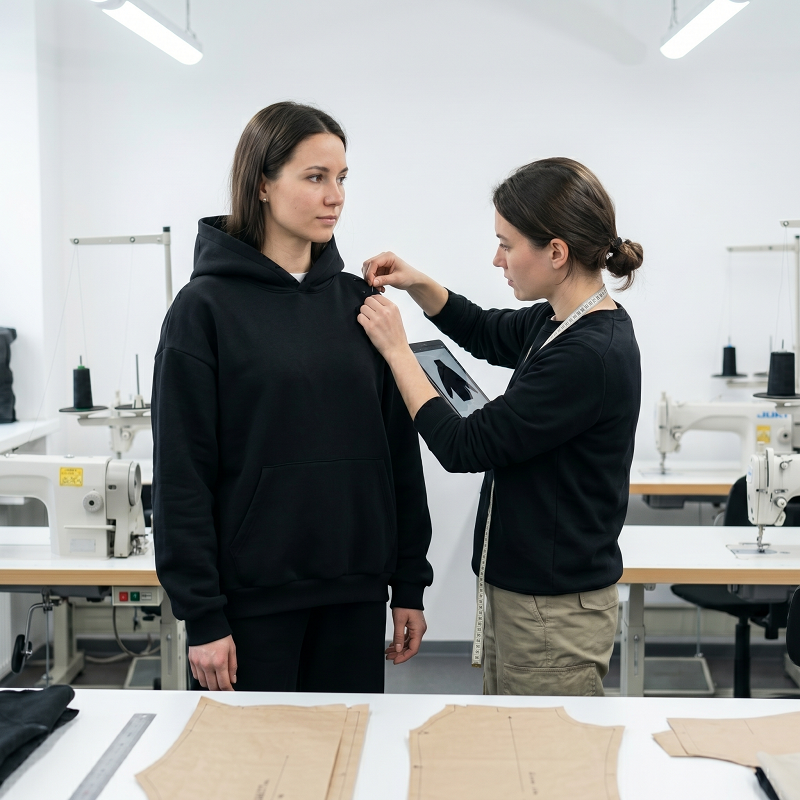
Before diving into bulk apparel production steps, sample making is an absolute safety mechanism that cannot be bypassed. The primary goal of this phase is to translate a two-dimensional tech pack into a three-dimensional physical garment, evaluating real-world feasibility.
1. The Typology of Sample Iterations
A standard industrial garment production line requires a methodical progression of sample check-offs:
Proto Sample / Fit Sample: Typically constructed using in-stock factory fabric of comparable weight (often in a neutral white or grey colorway). Its sole purpose is to evaluate the pattern draft, garment silhouette, and basic physical sizing on live fit models, verifying drape and range of motion.
Pre-Production Sample (PPS): This represents the final milestone before bulk clearance. The PPS must be manufactured using the exact custom-milled fabric, precise Pantone-dyed colors, finalized custom prints or embroideries, and all branded trims. It stands as the absolute manufacturing benchmark for the mass assembly line.
2. Vainnx's Ultra-Fast Sampling Turnaround
In the fast-paced world of fashion e-commerce, speed is an invaluable asset. As an agile apparel manufacturer, Vainnx operates an independent sample workshop capable of delivering completed samples within 3 to 7 days. Upon receiving your tech pack, our veteran pattern makers proactively identify hidden manufacturing risks—such as whether a heavyweight fleece will pucker during tight corner topstitching, or if an expansive screen print will crack during industrial washing—and provide immediate design remedies.
Phase 4: Pre-Production Planning & Pattern Grading
Once the brand manager signs off on the physical Pre-Production Sample (PPS) and authorizes the bulk deposit, the clothing factory initiates comprehensive production scheduling.
1. CAD Pattern Grading & Marker Making
Digital CAD Grading: Our technical pattern grading department inputs the approved sample dimensions into a specialized apparel CAD system. Using the grading formulas embedded in the tech pack, the software scales the dimensions up and down to create full-size ranges (from XS to XXL), ensuring the visual proportions of the streetwear silhouette remain identical across all sizes.
Marker Making Optimization: This step directly influences total material cost control. Fabric markers arrange all the multi-sized pattern pieces across a digital layout representing the exact width of the manufactured fabric roll. The objective is to maximize fabric yield (Vainnx consistently achieves 85% to 90%+ efficiency), minimizing textile waste to reduce the per-unit material costs for our clients.
2. The Pre-Production Meeting (PPM)
At the Vainnx manufacturing facility, no mass production line can begin without a formal Pre-Production Meeting. This cross-functional review unites the sales manager, production floor supervisor, lead technician, and head of the Quality Control (QC) department. Facing the physical PPS, the team reviews every complex assembly sequence and establishes clear boundaries for non-conformance, ensuring hundreds of workers on the line maintain a unified standard of craftsmanship.
Phase 5: The Bulk Manufacturing Assembly Line
This is the most critical phase of the custom apparel manufacturing process. Here, raw fabric rolls undergo a systematic industrial transformation into thousands of finished garments.
1. Spreading & Precision Cutting
Fabric Relaxation: Heavyweight knit textiles accumulate significant internal tension during tight roll-winding and transit. Prior to cutting, Vainnx spreads the fabric flat on long tables for 24 to 48 hours. This allows the fibers to relax completely, preventing garment twisting or extreme shrinkage after industrial washing.
High-Precision Lay Cutting: Relaxed fabrics are stacked in precise layers (frequently up to 100 plies thick), with the printed marker paper secured on top. Skilled technicians utilize high-capacity electric round knives or advanced computer-controlled automated cutting beds to slice the panels, ensuring geometric symmetry and alignment for subsequent sewing.
2. Bundling & Specialized Embellishments
Following the cutting stage, the separated garment panels are grouped into cohesive "bundles" tagged with unique tracking numbers to prevent batch cross-contamination or color shading discrepancies. Panels destined for complex graphic printing or heavy embroidery bypass the main sewing floor and move straight to specialized workshops.
In-House Execution at Vainnx: We execute a wide array of streetwear finishes, including direct-to-garment (DTG) printing, high-density traditional screen printing, durable high-elasticity puff printing, and artisan garment washing, ensuring the bulk output perfectly matches your digital artwork.
3. Sewing & Assembly Flow
This is the most labor-intensive phase of apparel production. Modern manufacturing facilities deploy a "Single-piece Flow" or "Modular Production" methodology:
Individual operators specialize in distinct, highly repeatable micro-operations: Operator A joins the shoulder seams, Operator B attaches the sleeves, Operator C sets the collar ribbing, and Operator D closes the side seams.
When assembling heavy streetwear, Vainnx implements specialized double-needle flatlock stitching and reinforced interior shoulder taping, guaranteeing the structural integrity of the garment through years of active wear and laundry cycles.
Phase 6: Six-Stage Quality Control & Branded Packaging
The ultimate differentiator between an elite international streetwear clothing manufacturer and an unvetted workshop lies within the execution of its quality assurance systems. Every single garment bearing the Vainnx manufacturing signature must pass our rigorous 6 Quality Inspection Processes before crate loading:
①Fabric Inspection (Raw Material Audit)
Inbound Quality Check
Utilizing automated fabric inspection machinery, our QC team inspects incoming textile rolls for color shading variances, skewing, weight irregularities, and physical flaws like yarn knots or surface stains.
②Cut-Piece Inspection
Pre-Sewing Alignment
Before components advance to the sewing or printing lines, inspectors conduct 1-to-1 dimensional audits against the master hard patterns to eliminate cutting defects at the source.
③In-Line Embellishment QC
Graphic Integrity
Panels undergoing screen printing, puff printing, or embroidery are fully verified post-cure to catch ink bleeding, alignment issues, or loose embroidery threads immediately.
④During Production Inspection (DuPro)
Mid-Assembly Audit
Roving QC inspectors continuously audit active assembly lines, checking stitch density (targeting 11–14 stitches per inch), identifying skipped stitches, or tension issues for immediate rework.
⑤Final Complete Garment Inspection
Post-Pressing Evaluation
Following final assembly and high-pressure industrial steam pressing, 100% of the bulk order enters the finishing zone. Every piece is measured against the size chart and meticulously trimmed of any remaining thread ends.
⑥Metal Detection & Final Packaging Audit
Safety and Compliance
All finished apparel must pass through an automated high-sensitivity conveyor belt metal detector. This guarantees that no broken sewing needle fragments remain embedded in the garments, ensuring absolute consumer safety. Finally, QC verifies that custom hangtags, branded polybags, and outer cartons match the client's shipping manifests.
Vainnx Manufacturing Capabilities At A Glance:
Flexible Low MOQs: Accommodating production runs from 50 to 100 pieces per style/color, supporting limited streetwear drops, startup brand testing, and rapid restocking strategies.
Reliable Lead Times: Sample completion within 3–7 days, Ready-Made garment modification in 7–15 days, and completely customized Full-Package Production (FPP) delivered within 4 weeks.
Global Supply Chain Logistics: Backed by an operations team with 20 years of export experience, serving premier street fashion labels across the globe with fully trackable door-to-door delivery networks.
Conclusion: Align with the Right Manufacturing Partner to Ground Your Brand Vision
Bridging the gap between an initial Tech Pack and thousands of premium, retail-ready garments requires a wealth of technical expertise and a highly structured workflow. The clean lines of minimalist streetwear often present the greatest technical challenges on the factory floor, requiring precise execution to pull off.
If your fashion brand is seeking a comprehensive streetwear clothing manufacturer that understands design trends, maintains a strict quality control system, and offers flexible minimum order quantities, Vainnx is built to be your long-term supply chain partner.
Explore our extensive manufacturing capabilities at https://www.vainnx.com/ or contact our development specialists directly at info@vainnx.com to launch your next custom project.
📞 Phone: [86-15015158179]
📧 Email: [info@chanjoye.com]
🌐 WhatsApp:[https://wa.me/8618025298509]
Click the link above to start designing your custom streetwear today. We can’t wait to help you express your bold style!