Inside the Streetwear Factory: How We Ensure Premium Quality in Bulk Apparel Manufacturing
- Share
- publisher
- 11
- Issue Time
- Jun 23,2026
Summary
This comprehensive playbook takes you deep within our state-of-the-art intelligent manufacturing facilities. We systematically break down how we master raw material curation, industrialize volatile retro finishing techniques,deploy cutting-edge textile embellishments, and enforce our absolute 8-step comprehensive quality control matrix. Bridge the gap between raw creative design and flawless, market-ready bulk garment engineering.

Introduction: The Streetwear Paradox — Balancing Mass Production and Premium Quality
In the contemporary, hyper-accelerated global fashion landscape, streetwear has decisively achieved its most magnificent historical metamorphosis. It has evolved from a localized, insular subcultural vernacular bound to skateboarding, graffiti, and hip-hop movements into the definitive, multi-billion-dollar commercial engine and cultural epicenter of the global apparel industry. From pioneering high-profile cross-pollinations between heritage luxury maisons and raw street brands on Paris and New York runways to anchoring the daily self-expression of Gen Z demographics globally, streetwear has rewritten the textbooks of apparel engineering. It demands unorthodox, complex silhouettes, aggressive, heavy-duty material structures, and an obsessive, granular focus on textile finishes that challenge traditional textile standardizations.
Yet, beyond the saturated glow of social media marketing and viral promotional content, global brand directors, independent design labels, and high-growth cross-border e-commerce merchants frequently operate under a catastrophic supply chain vulnerability: the severe quality cliff encountered when a design blueprint scales from a small-batch, artisan prototyping environment (10 to 50 pieces) into a high-speed, mass-production bulk assembly line (thousands of units).
Throughout the industry, the wreckage of mismanaged scaling is systemic. Prototypes arrive from the sample room looking flawless, yet the bulk production run exhibits deformed geometries that destroy the designed silhouette entirely. A single laundering cycle causes premium-priced knit garments to shrink aggressively or twist along the side seams due to unreleased textile torque. High-impact artistic graphics crack, peel, and flake after minimal wear; embroidery perimeters warp and pucker; and baseline hardware components fail under routine stress. These manufacturing defects do more than trigger wave after wave of expensive refunds and negative independent site reviews—they instantaneously annihilate the fragile, hard-won customer loyalty and brand equity that a label has poured years of capital and creative energy into establishing.
[Designer's Conceptual Silhouette]
│
▼ (Small-Batch Prototyping: 1-10 pcs)
[Flawless Artisan Samples]
│
▼ (Mass Scaling via Basic OEM Factories) ── Supply Chain Fracture ──> [Bulk Defects: Shrinkage, Torquing, Cracked Prints]
│ │
▼ (Strategic Scaling via Our Intelligent Infrastructure) ▼
[Premium Bulk Delivery: 100% Replication of Sample Quality] [Eradicated Brand Equity & High Refund Rates]
As a premiere, vertically integrated streetwear clothing manufacturer backed by extensive engineering expertise and highly automated production ecosystems, our organizational manifesto is non-negotiable: true premium streetwear quality cannot exist solely within a designer's vector tech pack or on high-saturation marketing lookbooks; it must be systematically manufactured directly into the garment across every mechanized knife cut, every calibrated industrial stitch, and every ruthless quality checkpoint.
Bulk apparel manufacturing must never be an apology for compromise. On the contrary, precise industrialization serves as the ultimate amplifier of quality. This definitive factory playbook strips away the historic opacity of the apparel supply chain. We demonstrate exactly how we fuse rigid industrial engineering with the uninhibited spirit of contemporary streetwear culture, ensuring that whether we are delivering a run of 500 or 50,000 units, every single garment delivers an uncompromised, luxury-tier luxury experience to global buyers.
Chapter 1: The Alchemy of Heavyweight Fabrics — The Foundation of Texture and Longevity
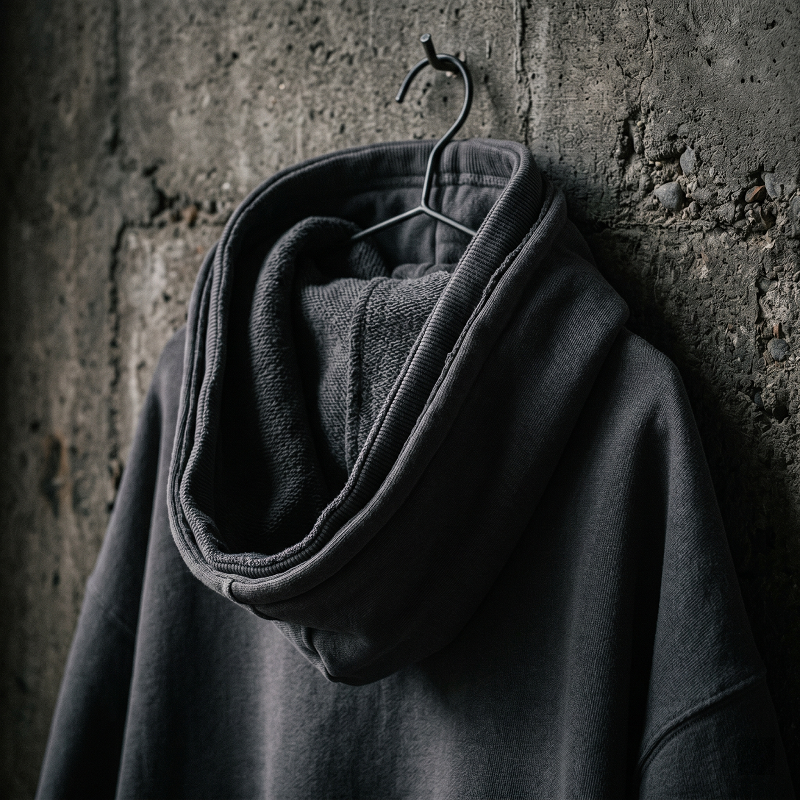
The primary architectural demarcation separating high-end luxury streetwear from standard fast-fashion blanks is an absolute, non-linear reliance on fabric texture, structural weight ("body"), and kinematic drape. A masterfully constructed streetwear hoodie, crewneck, or boxy tee must possess a substantial physical presence. This heavy hand-feel dictates the garment's visual volume, ensuring that it holds a rigid, architectural drape away from the wearer's body while maintaining supreme micro-climate comfort across all-day urban environments.
1. Engineering Massive Densities: The Physics of 400 GSM to 600 GSM Textiles
In mass-market apparel manufacturing, fabrics weighing 200g to 240g per square meter are routinely marketed as "heavyweight." In our manufacturing vocabulary, such metrics represent a baseline for entry-level products.
Heavyweight T-Shirts: To correctly manifest the structured, drop-shoulder, boxy aesthetics (Boxy Fit) favored by premium street labels, we deploy custom-milled 260 GSM to 300 GSM ultra-high-density combed cotton single jerseys. This tight knit structural configuration delivers superb breathability while providing the lateral structural stiffness required to prevent necklines from warping or body panels from sagging, entirely erasing the "disposable" reputation of fast-fashion apparel.
Heavyweight Hoodies & Sweatshirts: We specialize in the advanced engineering of 400 GSM, 500 GSM, and ultra-massive 600 GSM custom-knit French Terry and heavily brushed fleece fabrics. Processing these massive yarn densities demands high-tonnage, specialty circular knitting machinery configured with custom cam profiles to prevent structural barre marks and needle fractures. Our state-of-the-art knit infrastructure ensures that while the fabric surface remains incredibly smooth for subsequent graphic applications, the reverse loop structures are impeccably uniform. This massive material thickness infuses the garment with a luxurious weight, allowing brands to perfectly capture the dramatic drop-shoulder volume and structural oversized cocoons that dictate modern high-end streetwear.
+----------------------------------------------------------------------------------------+
| Streetwear Textile Density (GSM) & Silhouette Matrix |
+----------------------------------------------------------------------------------------+
| [200g - 240g Single Jersey] --> Standard Fast-Fashion Blanks --> Visual: Thin, Flat, Prone to Sagging |
| [260g - 300g Combed Jersey] --> Archival Boxy Streetwear Tees --> Visual: Rigid, Crisp, Zero Warping |
| [400g - 500g Premium Terry] --> Tier-1 Luxury Street Hoodies --> Visual: Volumetric Drop-Shoulder Drape |
| [500g - 600g Custom Fleece] --> Avant-Garde Structural Pieces --> Visual: Massive Weight, Rigid Envelope |
+----------------------------------------------------------------------------------------+
2. Raw Material Selection: Long-Staple Cotton and Advanced Yarn Count Matrices
To achieve absolute lot-to-lot color continuity and eliminate physical structural flaws across high-volume bulk runs, we entirely ban low-grade open-end yarns or reprocessed cotton scraps from our facility. Instead, we source premium long-staple cotton directly from certified agricultural growers.
Long-staple cotton fibers exceed 38mm in natural length, yielding significantly higher tensile strength and inherent fiber luster compared to standard short-staple cotton. Through a highly meticulous combing sequence, we strip away all short fibers, micro-neps, and organic impurities, retaining an ultra-aligned, high-strength fiber bundle.
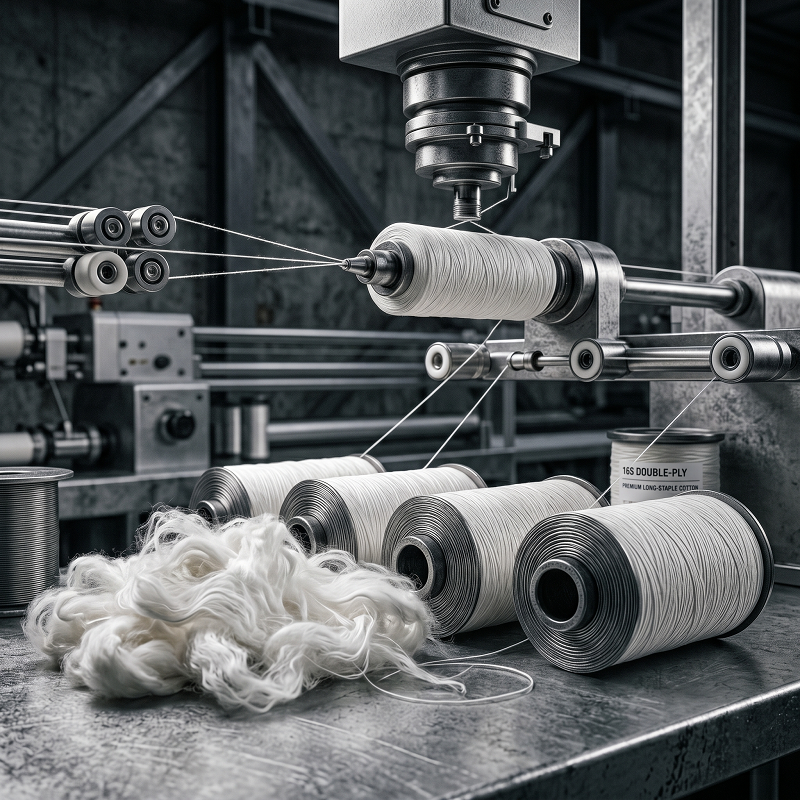
In designing yarn configurations, we balance rugged streetwear surface character with a premium hand-feel. For our 300 GSM heavyweight t-shirts, instead of relying on a single coarse yarn ply, we utilize 21S (21 singles) or 16S double-ply compact-spun yarns configured in a ply-twisted structure. Advanced compact spinning eliminates over 80% of surface hairiness (fuzz), producing a razor-sharp grain definition, pushing anti-pilling resistance to a premier international Grade 4.5 rating, and infusing the fabric with extreme multi-directional tensile stability. This ensures the bulk fabric never develops yarn slippage, pinholes, or localized thinning during the high-stress wash and print cycles downstream.
3. Eradicating Shrinkage and Color Bled: Tensionless Sanforization and Reactive Dyeing
Heavyweight knit fabrics naturally store immense structural residual stress generated during high-speed knitting loops. If left untreated before cutting, the finished garment will experience aggressive directional contraction and severe side-seam torquing upon its first domestic wash. To entirely nullify this systemic manufacturing defect across multi-thousand bulk unit operations, 100% of our knit fabrics must go through automated high-temperature steam tentering and continuous mechanical sanforization prior to entering the cutting room floor.
By running the textiles through specialized sanforizing units using rubber blankets and heated cylinders in an absolute tension-free state, the cotton fibers are forced to pre-relax and contract. This anchors our final bulk garment laundering shrinkage within an elite ±2% threshold, vastly outperforming the sloppy 5% to 8% shrinkage tolerances typical of low-tier commodity factories.
Furthermore, during the dye stage, we implement premium, low-liquor-ratio reactive dyeing systems using advanced overflow dye vats. The molecular architecture of reactive dyes forms a direct covalent bond with the hydroxyl groups of the cotton fiber, permanently fusing the pigment into the polymer matrix. Following the dye cycle, we apply a specialized high-performance fixing agent bath, raising color fastness scores across mechanical rubbing, laundering, and perspiration to Grade 4+. This ensures that no matter how many times the international consumer runs the streetwear piece through harsh domestic washing machines, the hues retain their original, deep saturation without bleeding or contaminating adjacent garments.
Chapter 2: Specialized Wash and Finishing Processes — Industrializing the Vintage Aesthetic and Brutalist Patina
Modern luxury streetwear aesthetics have long abandoned the sterile, clean finishes of traditional sportswear. Guided by the global resonance of archival garments, vintage Americana, and raw brutalist architectural tones, specialized treatments like vintage garment washes, distressed edges, chemical destructions, and acid washes have become mandatory design signatures. Global fashion consumers willingly pay exponential market premiums for a hoodie that carries a beautifully worn, naturally weathered patina that tells a visual story.
However, executing these aggressive finishings within a traditional mass-production framework is notoriously difficult—minor operational deviance easily tears the heavyweight fabric to shreds, creates massive lot-to-lot color variance, or distorts garment dimensions entirely. As an engineered streetwear custom supplier, we have modernized these historically erratic, artisan hand-treatments into digitally monitored, stable, and highly repeatable industrial bulk manufacturing pipelines.
+---------------------------------------------------------------------------------------------------+
| Digital Control Configurations for Vintage Aesthetics |
+---------------------------------------------------------------------------------------------------+
| 1. Acid Wash: Precise mapping of [Pumice Density] + [KMNO4 concentration 1.5%-3%] + [RPM 28-32] |
| 2. Sun-Fade Patina: Micro-calibration of [Cold Pigment Matrix] + [3D Atomization] + [Curing 140°C]|
| 3. Laser Distressing: CO2 Laser arrays operating at [10.6μm wavelength] + [15W-25W power output] |
+---------------------------------------------------------------------------------------------------+
1. Precision Acid Wash and Snow Wash Engineering via Digital Calibrations
The industrial execution of an authentic acid wash requires tumbling finished heavy garments inside specialized industrial horizontal wash cylinders alongside highly porous pumice stones pre-saturated with aggressive oxidizing chemical matrices, such as potassium permanganate. As the stones physically collide with the heavy fabric folds, seams, and ribbed edges, they selectively strip away surface pigments, rendering a natural, high-contrast marble or snow-flurried visual topography.
To ensure that the 1st unit and the 1,000th unit across a massive bulk apparel manufacturing run exhibit identical tonal depths and marble distribution, our operational parameters are strictly locked:
Standardized Stone-to-Garment Ratios: We mandate an exact weight-based ratio (e.g., 1:1.5) calibrated against the precise GSM profile of the lot, completely banning over-pulverized stones to maintain a constant physical friction coefficient.
Monitored Chemical Kinetics: The potassium permanganate solution is digitally dosed between 1.5% and 3%, machine cylinder rotation speed is locked at 28-32 RPM, and dwell times are controlled down to the second.
Absolute Neutralization Sequence: Post-wash, garments immediately transfer to high-capacity neutralization vats loaded with sodium metabisulfite. This 100% halts any lingering chemical oxidation, completely preserving the tensile tearing strength of the cotton fibers and ensuring the final garment is absolutely free of toxic odors, fully complying with rigorous global environmental mandates like EU REACH and RoHS protocols.
2. Advanced Sun-Fade Mapping and Cold Pigment Dyeing Architectures
To simulate the sophisticated look of a garment naturally weathered by years of intense equatorial solar exposure, standard garment-dyeing techniques fall short because they saturate the entire fabric uniformly, stripping away structural contrast. To address this, our engineering labs deployed a proprietary Cold Pigment Dyeing (CPD) framework combined with automated 3D atomization spray lines.
We initiate the process by loading raw, un-dyed heavyweight garments into a specialized cold pigment dye bath containing macro-pigment particles and cationic modifiers. Due to the high molecular weight of the cold pigment, it is physically prohibited from penetrating the internal core of the cotton fiber, intentionally bonding only to the outermost surface boundaries.
Next, the dried garments are suspended on an automated, multi-axis 3D spray conveyor line. Utilizing high-pressure, micro-atomizing nozzles driven by custom digital print maps, we apply precise localized fade vectors or fading catalysts to designed high-exposure zones—such as the crown of the hood, upper shoulder slopes, and kangaroo pocket lips. Following a highly calibrated curing run through industrial infrared tunnels at 140°C±2°C, the garment surfaces display a breathtaking multi-dimensional shadow play: raised edges showcase a chalky, sun-bleached contrast while recessed seam valleys retain rich, un-weathered deep pigments. This industrial calibration brings haute-couture hand-finishing directly into high-volume bulk runs.
3. Micro-Precise Laser Distressing Fused with Master Artisan Articulation
Frayed necklines, blown-out cuffs, and strategically shattered pocket borders add a rebellious, deconstructed luxury edge to streetwear garments. However, if a bulk factory relies entirely on operators using manual grinders or files, the output is not only painfully slow, but human fatigue inevitably causes catastrophic structural variance—frequently grinding entirely through the garment and producing un-repairable scrap.
Our factory completely bypassed this human-error bottleneck by integrating cutting-edge Intelligent CO2 Laser Distressing Systems. We digitally translate the designer's desired distressed motifs into vector destruction maps and exact power matrices within the laser's operating software.
During production, fabric panels or completed garments are anchored onto vacuum-assisted laser beds. The laser array, operating at a precision wavelength of 10.6μm, sweeps across the designated coordinates with micro-millimeter precision. The laser's thermal energy is calibrated to burn away only the outermost vertical warp threads of the cotton weave while leaving the horizontal weft threads completely intact. This creates an incredibly authentic, frayed, blown-out look with an operational tolerance of under 0.5mm.
Once the laser establishes the mathematically precise structural foundation, the pieces transfer to our specialized finishes department. Here, master artisans with over 5 years of dedicated experience use custom fine-gauge picks and scraping hooks to manually loosen and fluff the laser-weakened fibers. This hybrid execution of "digital laser mapping + artisan soul injection" ensures that while the bulk run never suffers from structural geometric drifting, the finished pieces retain an organic, authentic, non-uniform street character.
Chapter 3: Advanced Embellishment Tech — Translating High-Impact Artistry into Enduring Masterpieces

If premium fabric represents the physical body of a streetwear garment, then advanced prints and heavy embroideries serve as its explicit conceptual soul. Contemporary streetwear designs regularly feature ultra-expansive, over-the-seam graphics, multi-layered color scales, photorealistic oil painting reproductions, or high-relief structural embroideries. In high-volume bulk apparel manufacturing, guaranteeing that these complex, dense graphics survive the stresses of daily consumer wear and repeated industrial laundering without cracking, peeling, or stiffening the underlying knit fabric is a key indicator of a premier manufacturer's technical capability.
1. High-Polymer 3D Puff Printing: Complete Fracture Resistance Control
3D puff screen printing remains one of the most requested embellishment methods in modern streetwear due to its clean, sculptural, high-relief tactile presentation. The underlying chemical mechanism involves blending high-performance blowing agents into screen inks. When passed through downstream thermal curing tunnels, the blowing agent experiences thermal decomposition, releasing microscopic gas pockets that force the ink to expand vertically, generating a sharp, elevated three-dimensional profile.
Regrettably, standard factories frequently deliver bulk lots plagued by two massive defects: either the puff perimeters display fuzzy, blurred borders due to bleeding, or the graphic splits wide open when stretched. To permanently resolve this bulk manufacturing challenge, our facility implemented a dual-tier upgrade:
Medical-Grade Silicone Chemistry: We completely banned cheap PVC and low-grade rubber plastisol puff pastes from our ink rooms, replacing them exclusively with imported, high-viscosity medical-grade liquid silicone puff mediums. Silicone possesses immense inherent elasticity and structural elongation properties.
Automated Microcomputer Carousel & Tightly Regulated Curing: We deploy fully automated microcomputer-controlled carousel screen printing presses to execute multiple highly calibrated, uniform print strokes, establishing an un-deviated ink film thickness. The printed garments are immediately dispatched into a 15-meter industrial convection curing tunnel. We lock the curing temperature at exactly 165°C±2°C with a dwell time calculated down to 45 seconds. Under these highly engineered parameters, the high-polymer cross-linking network within the silicone medium reaches its absolute thermodynamic peak maturity. This results in incredibly smooth, rounded 3D puff structures with razor-sharp borders. Even if consumers perform an extreme 200% mechanical elongation across the graphic, the silicone stretches seamlessly and returns to a 100% flat resting state without ever showing a single micro-fracture.
+-----------------------------------------------------------------------------------------+
| Standard Puff Print vs. Our Premium 3D Silicone Puff Print |
+-----------------------------------------------------------------------------------------+
| Metric | Standard Commodity Factory Print | Our Engineered 3D Silicone Puff |
|--------------+----------------------------------+---------------------------------------|
| Ink Medium | Cheap PVC / Rubber Plastisol | Imported Medical-Grade Liquid Silicone|
| Edge Clarity | Blurred borders, bleed leakage | Razor-sharp, laser-like micro-borders |
| Elongation | Cracks/shatters past 20% stretch | 200% extreme stretch, 100% snap-back |
| Wash Cycles | Flakes & collapses after 5 washes| Survives 100+ commercial wash tests |
+-----------------------------------------------------------------------------------------+
2. The Ultimate Convergence of Print Tech: Hybrid Oval Digital-Screen Systems
Modern streetwear trends demand hyper-complex maximalist graphics, ultra-vibrant fine-art oil paintings, and hyper-realistic portraiture detailed down to microscopic skin pores. Traditional screen printing physically fails here due to the geometric limitations of mesh counts—it cannot cleanly execute infinite tonal gradations without generating visible, grainy half-tone dot patterns. Conversely, directly executing standard direct-to-garment (DTG) printing across bulk lots of 500 GSM loopback cotton is a recipe for failure; the highly irregular, fibrous surface of the heavy knit absorbs the micro-ink droplets unevenly, rendering a dull, washed-out graphic that lacks the rich, museum-grade color saturation that premium street culture dictates.
To shatter this barrier, our production floor integrates state-of-the-art Industrial Hybrid Oval Digital-Screen Printing Systems. This represents the absolute pinnacle of modern textile embellishment, synthesizing screen and digital mechanics in a synchronized inline array:
Automated Screen Under-Basing: The initial modules of the oval system apply a highly calibrated base layer of premium white water-based elastomeric ink or a high-performance eco-friendly discharge ink matrix. This under-base flatlocks and seals down all surface hairiness of the heavyweight fabric, engineering a perfectly uniform, high-opacity, smooth digital "canvas" right on the fabric face.
Piezo-Electric High-DPI Digital Jetting: The fabric panel then glides seamlessly into the digital printing zone. Industrial-grade piezoelectric printheads, operating at an ultra-fine 1200 DPI resolution, jet premium reactive textile inks directly onto the fresh, un-cured screen under-base.
This revolutionary process delivers the absolute best of both worlds: the unyielding wash durability, zero dye migration, and rich color pop of industrial screen printing combined with the multi-million color depth and crisp detail of digital inkjet systems. Complex artistic smoke, multi-layered fire gradients, and photorealistic imagery are cloned perfectly across thousands of bulk pieces without a single pixel of compromise.
3. High-Density Heavy Embroidery Powered by Japanese Tajima Arrays and Cold-Water PVA Film
Beyond ink applications, high-density embroidery is a crucial design pillar for streetwear labels, utilized to render varsity chenille lettering, historical patches, and bold crests. Generic factories deliver thin stitch counts that allow the base fabric to show through, and when embroidery needles strike heavy 500 GSM loopback cotton at high speeds, the surface loops of the knit fabric inevitably poke out through the embroidery threads, making the graphic perimeter look fuzzy and poorly executed.
To ensure every bulk order mirrors luxury-tier clarity, our embroidery division operates a fleet of imported Japanese Tajima Multi-Head Computerized High-Precision Embroidery Arrays. Our bulk production metrics are exceptionally demanding:
Elevated Stitch Densities: We program all embroidery files with a 30% higher stitch density compared to standard commercial apparel benchmarks, specializing in dense satin fills, heavy tatami fills, luxury towel chenille, and multi-layered fabric appliqués.
Cold-Water-Soluble PVA Film Technology: When embroidering heavyweight French terry or brushed fleece, our operators overlay a specialized sheet of cold-water-soluble Polyvinyl Alcohol (PVA) film directly over the face of the fabric before the machine heads engage. As the precision embroidery needles punch through the PVA film at 1,000 RPM, the film acts as an impenetrable physical shield, locking down all surface fleece loops flat against the core fabric. Once embroidery concludes, the completed garments go through a brief warm-water wash cycle; the PVA film instantly and completely dissolves into liquid without leaving a trace of chemical residue. What remains is an embroidery graphic of striking clarity—every typographic serif and design vector stands perfectly elevated, packed with ultra-dense thread counts, entirely eradicating the common issues of fabric grin-through or rough, fuzzy borders.
Chapter 4: The Digitalized Production Line — Pattern Optimization, Tension-Free Spreading, and Heavy-Duty Stitching
Superior streetwear construction relies heavily on "the engineering of subtle dimensions." Low-tier clothing factories operate under the naive delusion that streetwear simply means scaling a base pattern up into a basic, oversized square box. This is an engineered failure. The magic of a premier boxy tee, cropped hoodie, or wide-leg street trousers rests upon advanced structural kinetics: an extra centimeter of drop on a shoulder pitch, an exact millimeter of reduction on a sleeve cuff taper, or the specific compression torque of a waistband rib can completely make or break the garment's visual energy on the wearer.
In executing large-scale bulk apparel manufacturing, we have abandoned antiquated manual scaling systems, migrating our entire pre-production and assembly line into a fully digitized, intelligent ecosystem. This guarantees that from the 1st unit to the 10,000th unit, the pattern dimensions remain flawlessly anchored to the approved design.
[Cloud-Based CAD Prototyping & 3D Kinematic Testing]
│
▼ (Digital Pattern Vector Export)
[Automated Zero-Tension Fabric Spreading Platforms] ──> (24-Hour Material Relaxation State)
│
▼ (Zero Tension Sheet Feeding)
[Computerized CNC Optical Laser Cutting Array] ──> (Sub-0.5mm Geometric Perfection)
│
▼ (Component Sorting Routing)
[High-Torque Synchronized Direct-Drive Sewing Cells] ──> (Four-Needle Six-Thread Flatlock & Triple Chainstitch)
1. Cloud-Based CAD Grading and 3D Kinematic Motion-Stress Simulations
Upon finalizing the creative design maps or analyzing a vintage reference garment supplied by our clients, our master pattern engineering team maps the structural geometry into advanced apparel-specific CAD software packages.
Standard commercial pattern grading scales garment sizes (from S to XXL) linearly, which routinely results in larger sizes looking like unstructured tents and smaller sizes losing their designed boxy character entirely. Our design laboratory deploys non-linear, matrix-based grading protocols meticulously tuned for oversized streetwear parameters. This ensures that regardless of whether the final customer purchases a size Small or Double-XL, the exact volumetric drape, drop-shoulder slope, and cropped waist proportions are maintained.
To dramatically truncate the historically slow, costly cycle of physical sampling, shipping, and physical modification, our factory utilizes advanced 3D Kinematic Garment Simulation Engines. Our engineers import the raw CAD digital slopers directly into the virtual environment and inject the precise physical property metrics of our custom 400g-600g heavyweight fabrics—including measured bending rigidity, shear modulus, fabric friction coefficients, and exact GSM weight values.
The software compiles this data to generate a highly accurate, real-time render of how that heavy textile will behave, drape, fold, and pool over dynamic, moving digital 3D human avatars. Guided by digital multi-directional stress maps, we can identify and correct potential fit issues—such as rear collar restriction, chest distortion, or uneven hem balance—digitally before a single real fabric roll is ever sliced.
2. Total Eradication of Side-Seam Torquing: Automated Spreading and CNC Cutting Beds
During high-volume bulk cutting operations, manual fabric spreading is highly prone to introducing errors. When workers pull heavy knit fabric rolls across long cutting tables by hand, they inadvertently apply intense physical tension. Once the fabric is cut into panels and assembled into garments, these trapped internal stresses naturally release, causing the completed t-shirt or hoodie to twist violently sideways after its first wash (an industry defect known as "side-seam torquing").
Our cutting department entirely eliminates this issue by operating a fleet of Fully Automated Intelligent Fabric Spreading Machines:
Zero-Tension Micro-Sensor Feeding: The machine’s motorized feeding cradle utilizes real-time micro-sensors to actively detect fabric slack, laying out the heavy material onto the cutting tables in a completely relaxed, zero-tension state.
Atmospheric Relaxation Phase: Once the massive fabric plies are stacked, the materials are mandated to rest and relax for a minimum of 24 consecutive hours inside our climate-controlled cutting rooms, letting the fibers completely release all spinning and knitting stresses.
CNC Automated Precision Knife Cutting: The relaxed fabric stacks are then driven into computer-driven CNC Automated Knife and High-Power Laser Cutting Beds. Configured with automated overhead computer-vision camera arrays, the system continuously reads and maps the grain lines of custom-printed or vintage plaid textiles, instantly re-calibrating the cutting path to achieve millimeter-perfect alignments. The computer-driven alloy cutting heads operating under high-capacity vacuum compression cut the panels with an accuracy metric of under 0.5mm. This guarantees that every sleeve panel and body component is geometrically identical, completely eradicating asymmetric sleeves or warped bodies from our bulk outputs.
3. Heavy-Duty Direct-Drive Sewing Machinery and Triple-Needle Structural Reinforcements
Assembling multi-layered 500 GSM+ heavy knit fabrics or double-layered custom puff jackets presents a massive physical challenge for standard sewing machines. Standard apparel sewing units lack the driving torque required to pierce these dense textile sandwiches smoothly, resulting in skipped stitches, broken needle tips, and erratic stitch lengths that look highly unprofessional.
Our assembly floors enforce a rigid machine-to-fabric specification protocol. For all heavyweight streetwear operations, our production lines are armed exclusively with heavy-gauge, microcomputer-controlled direct-drive sewing systems engineered for ultra-heavy duty materials.
Four-Needle Six-Thread Flatlock Seaming: When constructing the interior crotch lines of premium heavy sweatpants or assembling the multi-paneled hood constructions of our hoodies, we implement advanced four-needle, six-thread flatlock stitching systems—machinery traditionally reserved for elite compression sportswear. This engineering creates an completely flush, abrasion-free flat seam on the inside of the garment, while exposing a wide, rugged, highly industrial stitching track on the exterior face. This clean line effortlessly double-hats as a distinct aesthetic design marker popular within modern brutalist fashion.
Triple-Needle Chainstitching Arrays: Along high-stress garment intersections that endure severe daily mechanical stretching—such as the rear neckline binding, the main drop-shoulder seams, and the armhole junctions—we implement an unyielding triple-needle, five-thread chainstitching reinforcement profile using high-tensile, multi-filament low-elasticity polyester industrial threads. This heavy-duty assembly architecture gives the clothing a structural, armored美学 identity, while ensuring the garment can withstand extreme physical strains from action sports like skateboarding, breakdancing, and street basketball without ever experiencing a seam blowout or structural unravelling.
Conclusion: Align Your Brand with a Master Streetwear Manufacturer
In the hyper-accelerated, borderless digital landscape of modern streetwear commerce, a brilliant visual concept, paired with precise social media storytelling and high-intent independent site traffic, can undeniably propel a startup brand into sudden, viral global visibility.
However, once the initial marketing hype cools, and once the noise of social media metrics settles into analytical consumer evaluation, the core structural moat that preserves a brand's longevity, drives high repeat purchase rates, and allows a streetwear label to go toe-to-toe with legacy luxury houses is an absolute, unwavering, high-tier bulk manufacturing supply chain capable of flawlessly replicating artistic design details across every single production run.
We have never operated as a generic clothing factory that mechanically passes fabric beneath sewing needles. At https://www.vainnx.com/, we operate as your brand's highly specialized, deeply technical, and completely aligned supply chain co-pilot. From the strict calculation of heavyweight yarn counts and fibers to the digital execution of vintage brutalist patinas and the absolute defense of our 8-step quality protocol, we build custom clothing with artistic reverence and industrial precision.
If your fashion house is actively searching for a strategic clothing manufacturer equipped to conquer complex, high-heavyweight, and heavy-embellished bulk production runs—and if you are ready to permanently escape the supply chain nightmares of inconsistent quality—we invite you to map your future with us. Visit our official independent platform at https://www.vainnx.com/ to sync with our engineering teams. Let’s translate your grandest design concepts into a tangible, premium global street reality that dominates the market.
📞 Phone: [86-15015158179]
📧 Email: [info@chanjoye.com]
🌐 WhatsApp:[https://wa.me/8618025298509]
Click the link above to start designing your custom streetwear today. We can’t wait to help you express your bold style!