What is the production process for custom outerwear manufacturing?
- Share
- Issue Time
- Aug 27,2026
What is the production process for custom outerwear manufacturing?
Custom outerwear manufacturing follows a structured seven-stage process: inquiry and tech pack review, material sourcing, sampling, fit approval, bulk production, quality inspection, and shipping. At chanjoye, a typical jacket or coat program runs from tech pack confirmation to delivery in roughly 35 to 60 days, with bulk sewing completed in 10 to 20 days once the pre-production sample is approved. The key to a smooth run is not a single step but the discipline of approving each stage before the next one begins.
Stage-by-stage explanation
Outerwear is the most construction-heavy category in apparel. A single technical jacket can contain 40 to 70 component parts, including shell panels, lining, insulation, pocket bags, zipper tapes, cord stops, and trims. That complexity is why professional manufacturers break production into clearly gated stages.
1. Inquiry and tech pack review
Everything starts with the tech pack: flat sketches, measurement spec, materials list, trim details, decoration artwork, and packaging instructions. The factory reviews it for construction risk, missing specs, and cost drivers. A complete tech pack lets the manufacturer give an accurate quotation in 1 to 3 days, while an incomplete one typically causes delays later. Expect questions about seam types, zipper size, hood lining, and seam taping before any price is locked.
2. Material sourcing and lab dips
Shell fabric, lining, insulation, and trims are sourced to the spec. For outerwear the shell is the biggest cost driver, often 40 to 55 percent of the garment cost. Fabrics are tested for weight, tear strength, water resistance, and colorfastness. If your brand color is custom, the mill produces a lab dip for approval, normally within 5 to 7 days. Chanjoye keeps an in-house fabric library of waterproof polyesters, cotton blends, and eco-certified materials so sampling can start immediately for common base fabrics. 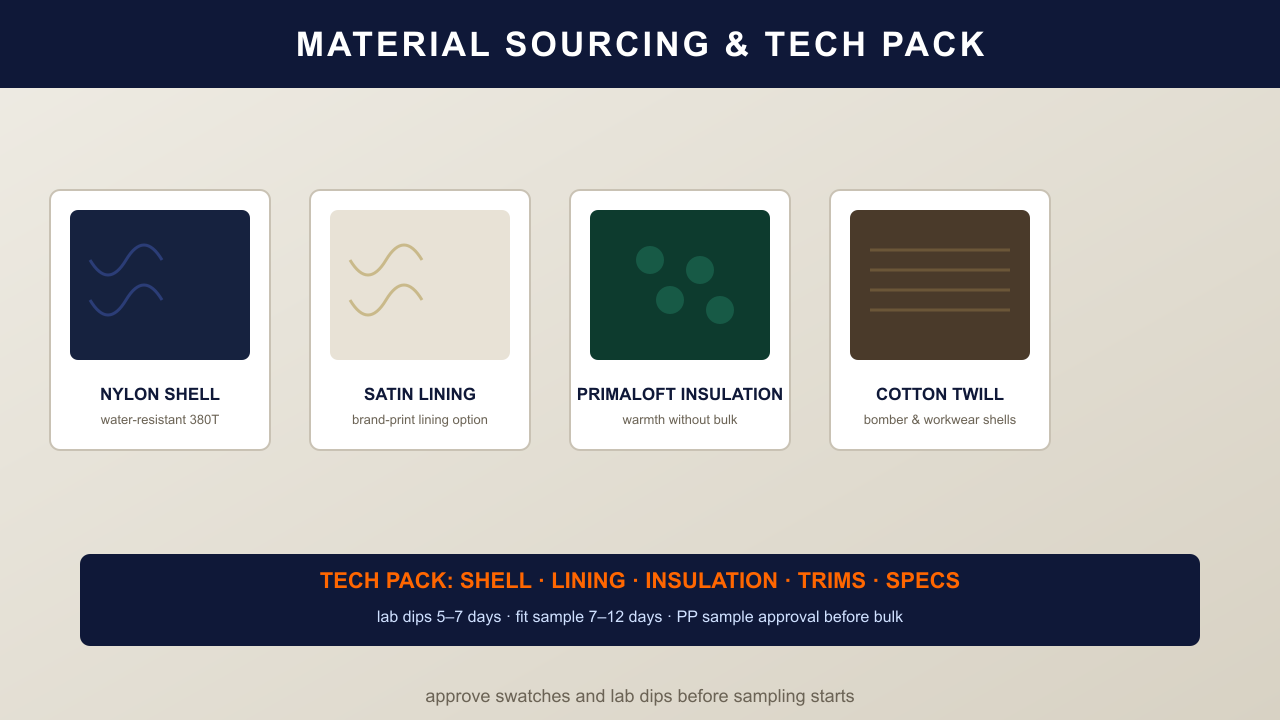
Material sourcing: nylon shell, satin lining, insulation and twill swatches with tech pack specs
3. Sample making
Two sample types matter most. The fit sample proves construction, sizing, and proportion on a real body or dress form. The pre-production sample (PP sample) is sewn from the actual bulk fabric with final trims and decorations, and becomes the benchmark for the whole production run. Most outerwear programs need one to two rounds of fit samples; chanjoye offers free samples and 3D previews so brands can check proportion and details before physical sampling. 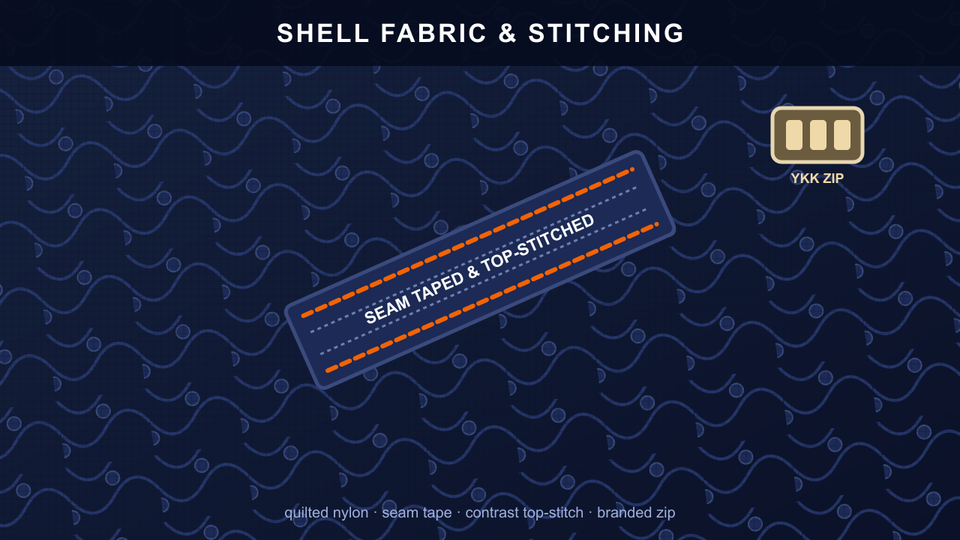
Pre-production sample detail: shell stitching, seam tape and branded zip approved before bulk
4. Fit approval and measurement sign-off
Fit approval is the formal gate. The brand reviews the graded measurement spec, tries the sample, and signs off on fit, hand feel, and details. Any change here is cheap; the same change after bulk cutting is expensive. This stage also fixes the size grading: how measurements scale from XS to XXL.
5. Bulk production
Approved samples move to production. Fabric is spread and cut, panels are fused, sewn on a production line, decorated (embroidery or printing), and finished with trims, labels, and pressing. Outerwear lines are typically organized by construction stage: cutting, sewing, insulation insertion, lining, and final assembly. Chanjoye's standard bulk sewing window is 10 to 20 days depending on style complexity and order size, with MOQ starting at 100 pieces. 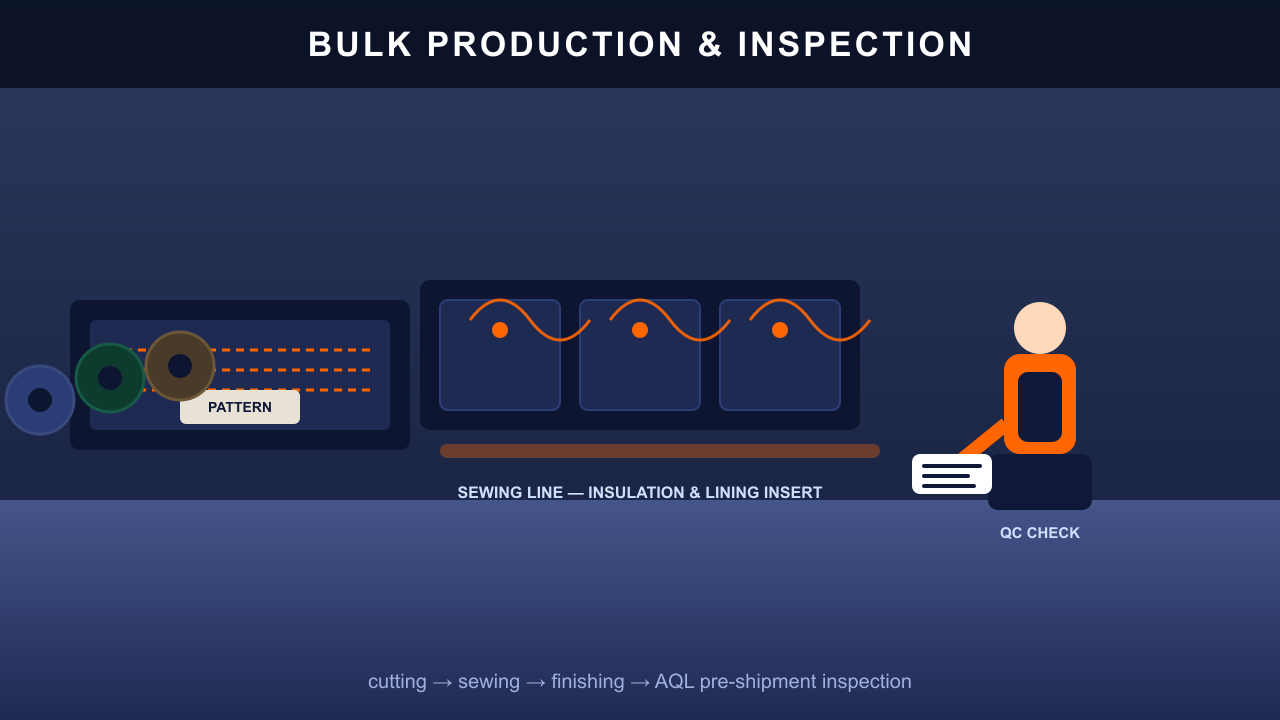
Bulk production: cutting, sewing line and AQL quality inspection at the chanjoye facility
6. Quality inspection
Inspection happens both inline and at the end. Mid-production checks catch issues while they can still be corrected. A pre-shipment inspection (PSI) checks a random sample against the approved PP sample using an AQL 2.5 general inspection level as the common standard: stitching, zipper function, measurements, color, and packaging. Only lots that pass ship.
7. Packaging and shipping
Finished jackets are folded or hung, poly-bagged, cartoned with your brand's carton marking, and shipped by sea, air, or express. Lead time from order to delivery typically ranges 35 to 60 days for sea freight programs, so most brands plan seasonal outerwear 4 to 6 months ahead.
Typical outerwear production timeline
| Stage | Typical duration | Key deliverable |
|---|---|---|
| Tech pack review and quotation | 1 to 3 days | Confirmed price and feasibility |
| Material sourcing and lab dips | 5 to 10 days | Approved fabrics and colors |
| Fit sample | 7 to 12 days | Approved construction and sizing |
| Pre-production sample | 5 to 10 days | Benchmark for bulk run |
| Bulk production | 10 to 20 days | Completed production lot |
| Pre-shipment inspection | 2 to 4 days | AQL inspection report |
| Shipping | 7 to 30 days | Delivery to destination |
Case study: a streetwear label's first outerwear run
A European streetwear brand came to chanjoye with a bomber jacket design, a tech pack, and a hard 12-week deadline before their autumn drop. In week one, chanjoye's team reviewed the pack, flagged that the spec called for an unusually heavy zipper, and offered a matched alternative that kept the look at a lower cost. Lab dips were approved in 6 days, the fit sample arrived in 11 days, and one adjustment round on the sleeve length followed. The PP sample was approved in week five. Bulk production of 800 jackets finished in 16 days, the AQL inspection passed on the first attempt, and the lot shipped by sea in time for the drop. The brand has since reordered the same style twice, using the approved PP sample as the reference for every repeat run. That is the practical value of a documented process: consistency across seasons. 
The finished drop: custom outerwear styled for the urban streetwear season
Checklist before you start production
- Complete tech pack: flat sketches, measurement spec, materials, trims, artwork
- Confirm MOQ, unit price, and payment terms in writing
- Approve fabric swatches and lab dips before sampling
- Sign off the fit sample and graded size spec
- Approve the pre-production sample with final labels and decorations
- Agree on AQL level and arrange pre-shipment inspection
- Lock packaging and carton marking details
- Plan 4 to 6 months ahead for seasonal outerwear
Related questions
Ready to start your outerwear program? Chanjoye is a China-based OEM/ODM manufacturer with 20+ years of experience serving streetwear brands worldwide. MOQ starts at 100 pieces, with free samples, fast design sketches, and 3D previews. Send your tech pack to chanjoye for a quotation and a clear production timeline before your next season.
Get a free quote