What is the difference between custom fashion jackets and standard wholesale jackets?
- Share
- Issue Time
- Oct 22,2026
Jacket sourcing guide
What is the difference between custom fashion jackets and standard wholesale jackets?
The difference is who owns the pattern. A custom fashion jacket is developed for your brand: your measurements, your fabric, your trims, your label, produced only for you. A standard wholesale jacket is a finished style that a factory already developed and sells to many buyers, usually with only the label and colour changed. Custom costs more upfront and takes longer; wholesale is faster and cheaper per piece, but the fit and design are shared with every other buyer of that style.
Choose custom when
the jacket carries your brand identity, the fit is part of the product, or you need exclusive fabric, hardware or branding.
Choose wholesale when
you are testing a market, filling a range quickly, or selling a basic where the lowest unit cost matters more than exclusivity.
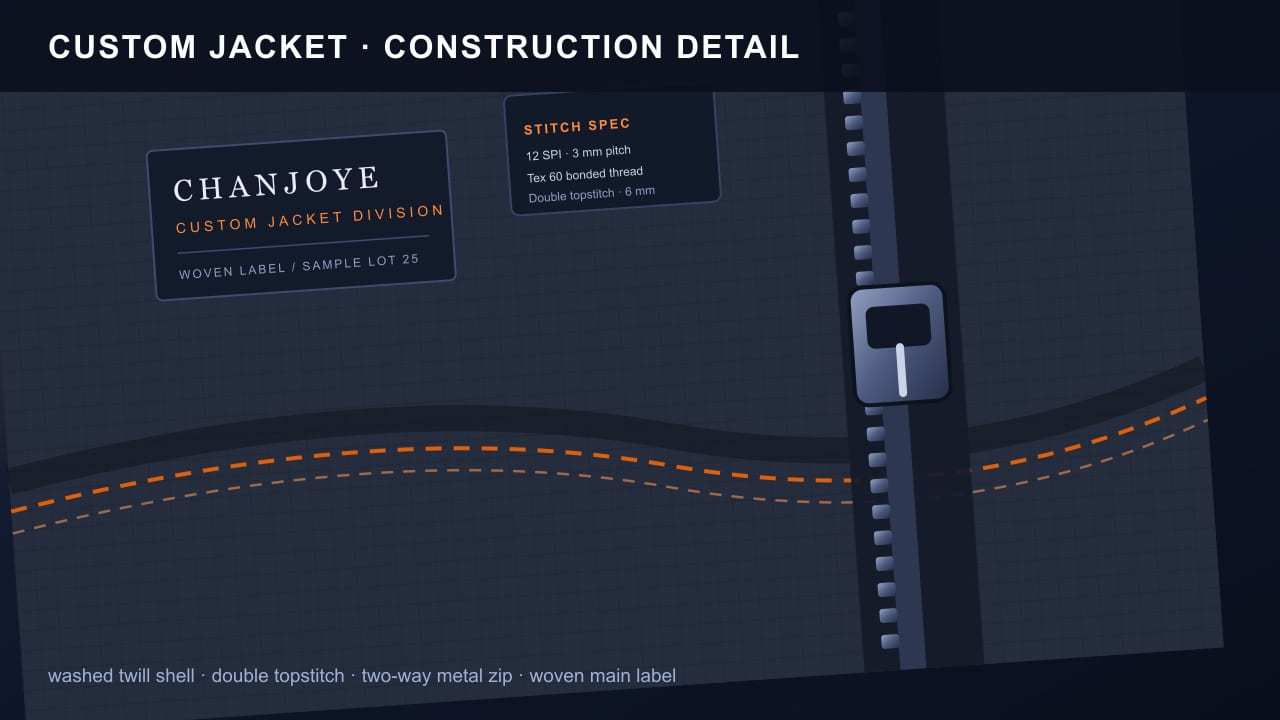
Construction detail: double topstitch, two-way metal zip and woven main label on a custom jacket
The six differences that actually change your decision
Most supplier quotes do not state which model they describe, which makes them impossible to compare. These six points separate the two models in practice.
1. Design origin
Custom starts from your design intent, technical sketch or reference sample. The factory builds a pattern, makes a sample, and only then cuts bulk. Wholesale starts from a style that already exists in the factory catalogue.
2. Fit and grading
Custom controls chest, shoulder, sleeve pitch, body length and the full size curve. Wholesale keeps the factory's block, so a size M is whatever that factory decided M means.
3. Materials and trims
Custom lets you specify shell weight, lining, insulation, zips, snaps, ribbing and thread. Wholesale is limited to the fabric and trims already loaded on that style, sometimes with a small colour card.
4. Branding depth
Both can carry your label. Custom adds woven main labels, printed care labels, custom hangtags, branded zip pulls, embossed hardware, interior taping and retail-ready polybags as part of the build.
5. MOQ and cost structure
Wholesale MOQ is usually lower because the style already runs. Custom MOQ is set per style and often per colour, because each colour is a separate cutting setup, but the unit price falls as volume grows.
6. Exclusivity
A wholesale style can be bought by any competitor who finds the same supplier. A custom pattern cannot be copied directly; a competitor would have to develop it again from scratch.
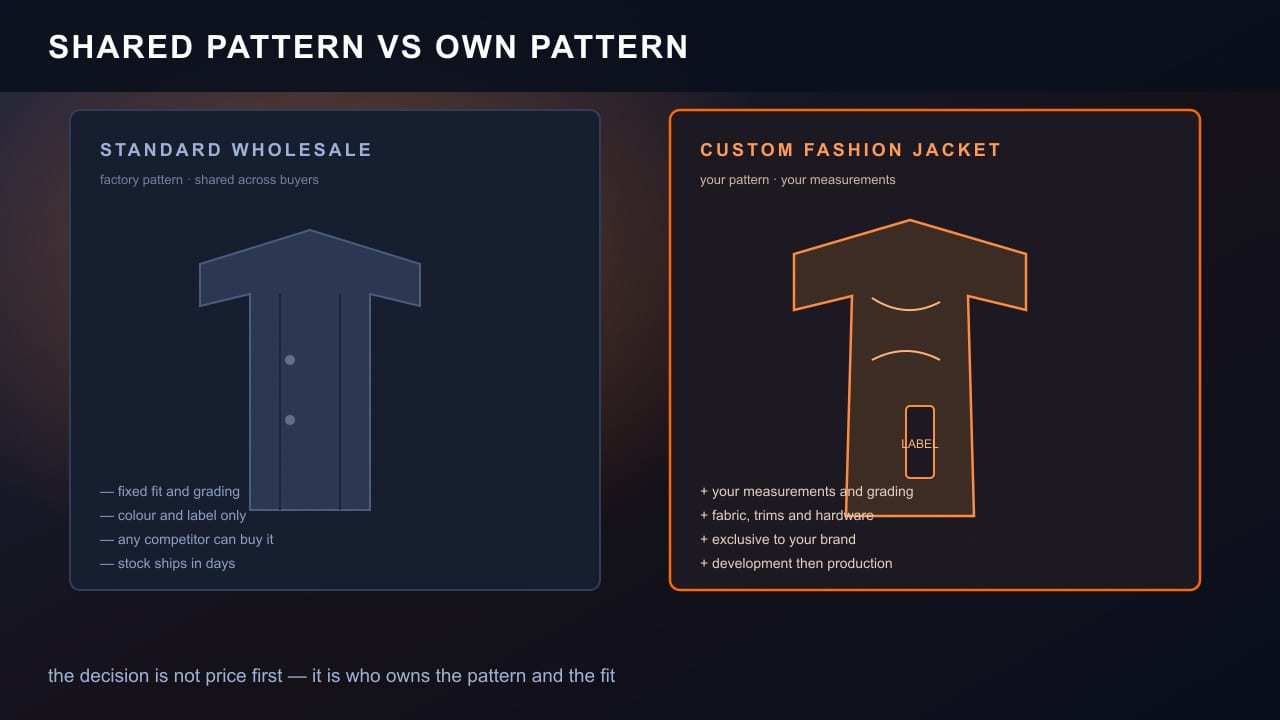
Shared factory pattern versus a brand-owned pattern: fit, materials and exclusivity
Side-by-side comparison
The figures below reflect common jacket production practice in 2026. Treat them as planning ranges, not fixed prices, because fabric, trims and order size move every line.
| Decision factor | Custom fashion jacket | Standard wholesale jacket |
|---|---|---|
| Pattern owner | Your brand | The factory |
| Design source | Your tech pack, sketch or reference | Existing catalogue style |
| Fit control | Full: measurements, grading, sample fit rounds | Fixed block, no pattern changes |
| Fabric and trims | Specified by you, sourced or approved | Factory's existing options |
| Branding | Labels, tags, hardware, packaging, interior details | Usually main label and hangtag only |
| Typical MOQ | 100 to 300 pieces per style | 50 to 100 pieces, sometimes less per colour |
| Sampling | 1 to 2 rounds, 7 to 14 days each | Stock sample or swatch card, days |
| Bulk lead time | 25 to 45 days after sample approval | 3 to 15 days from stock |
| Unit cost at 300 pieces | Higher, falls with volume | Lower at the same volume |
| Exclusivity | Your pattern, not resold | Shared with other buyers |
| Best use | Signature pieces and core identity | Market testing, basics, range fill |
Read the quote carefully. If a supplier cannot say who owns the pattern and who buys the fabric, the price is not comparable to a custom quote. Ask those two questions before discussing cost.
What custom development actually adds
A custom jacket programme runs through five stages that a wholesale order skips entirely. Each stage is a cost, and each one is also a control point.
Technical file
Measurements, construction notes, stitch types, branding placement and packaging are written down before anything is cut.
Pattern and grading
A base size is drafted, then graded across the size curve. This is the step that decides whether the jacket fits your customer.
Fabric and trim sourcing
Shell, lining, insulation, zips, ribbing and labels are sourced or approved, with lab dips and swatches signed off.
Fit and PP samples
A fit sample confirms proportion and measurement; a pre-production sample confirms fabric, colour and branding before bulk.
Bulk and inspection
Marker cutting, line sewing, inline checks and a final AQL inspection before packing and shipment.
Wholesale collapses all five into a catalogue page. That is why it is faster, and also why two brands selling the same wholesale jacket end up with an identical product.
Case study: a 300-piece custom bomber programme
A European streetwear label needed a washed-denim bomber that did not exist in any catalogue. The brief was specific: a boxy body, dropped shoulder, 12 oz denim, antique brass hardware, a jacquard main label and three colourways for a first drop.
chanjoye drafted the pattern from the brand's reference garment, adjusted the shoulder drop after the first fit sample, and matched the wash across all three colourways before bulk. Because the pattern stayed with the brand, the second drop repeated the same fit without a new development cycle, and the reorder ran from the existing pattern and approved fabric.
This is the practical difference: the first order funds development, and every reorder after it becomes faster and more consistent. A wholesale jacket never reaches that point, because the fit was never yours to repeat.
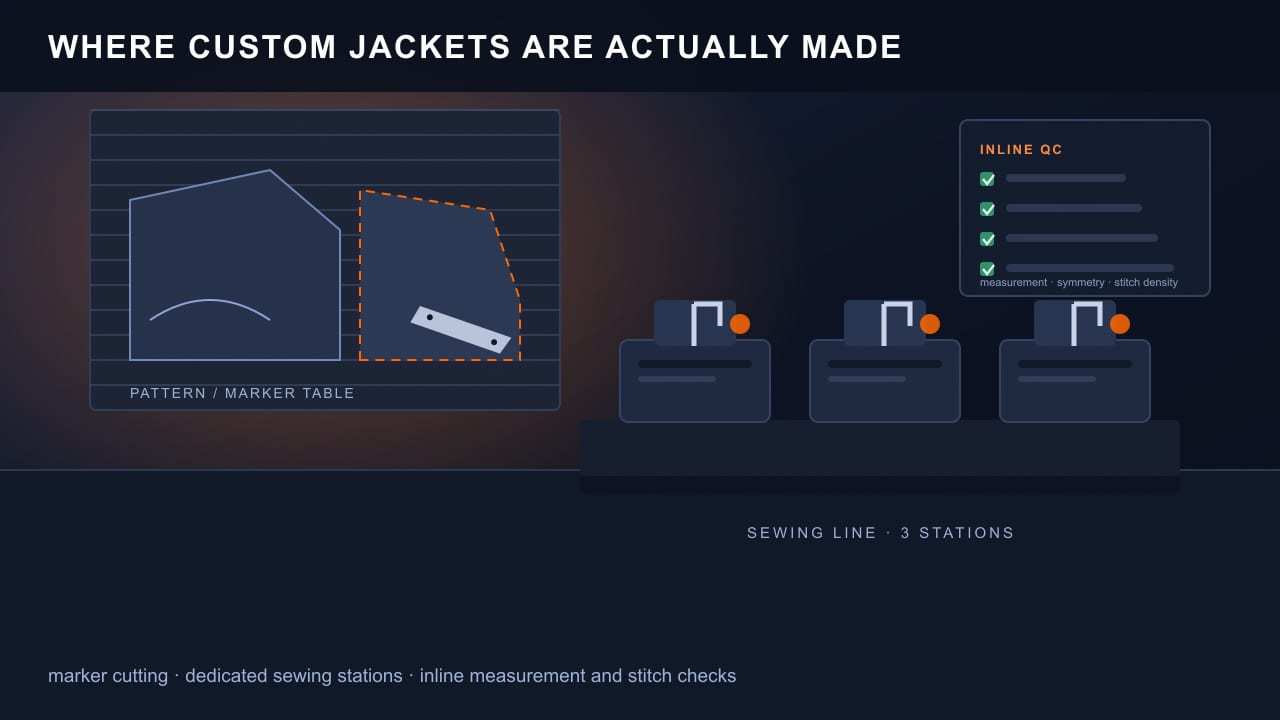
Custom jacket production: marker cutting, dedicated sewing stations and inline measurement checks
Checklist before you choose a model
- Confirm who owns the pattern and whether it can be reused for reorders.
- Ask whether the quoted MOQ is per style, per colour, or per style across colours.
- Request fabric swatches and a lab dip before approving any colour.
- Get the measurement spec in writing, including tolerance per point.
- Approve a physical sample, not only a photo or a 3D render.
- Confirm branding: main label, care label, hangtag, zip pull and packaging.
- Agree the inspection standard and who pays for a third-party inspection.
- Ask for the reorder lead time before you place the first order.
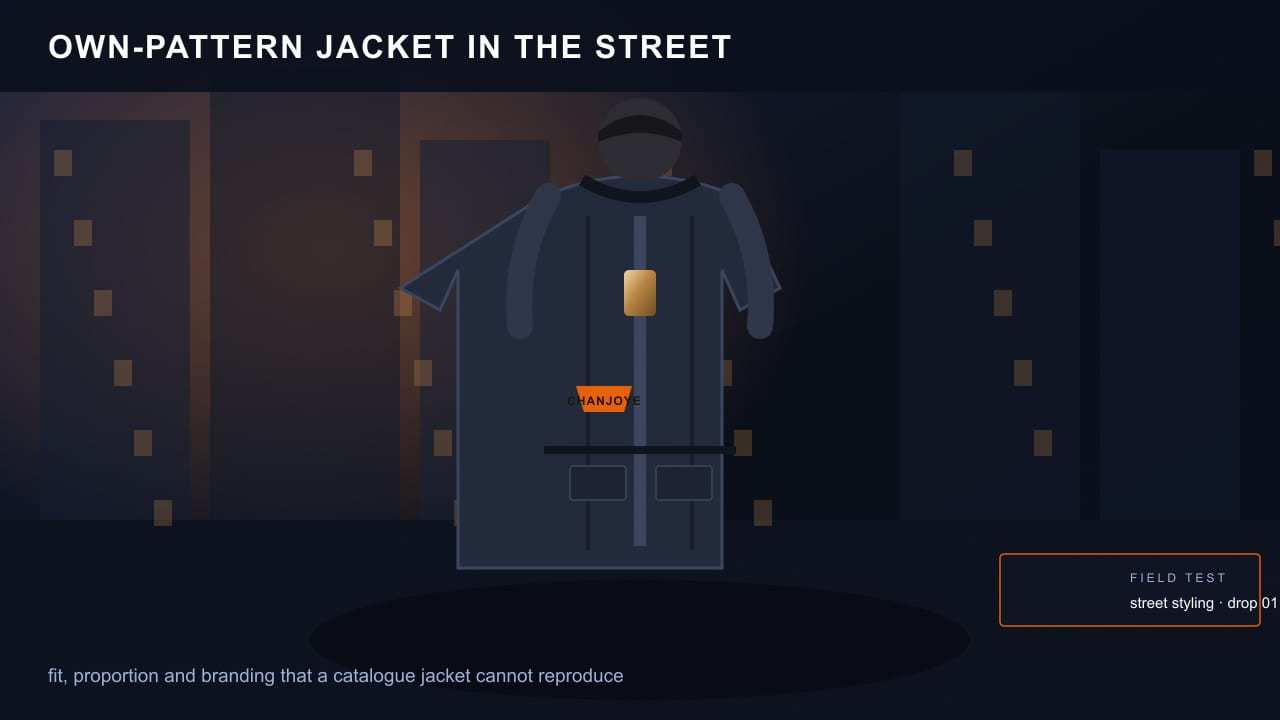
The finished custom jacket in a streetwear context, styled for a first drop
Related questions
Need a jacket that is actually yours?
chanjoye develops custom fashion jackets from your sketch, tech pack or reference sample, with MOQ from 100 pieces, fabric and trim sourcing, branding development and pre-shipment inspection handled by one team.
Send your jacket brief